

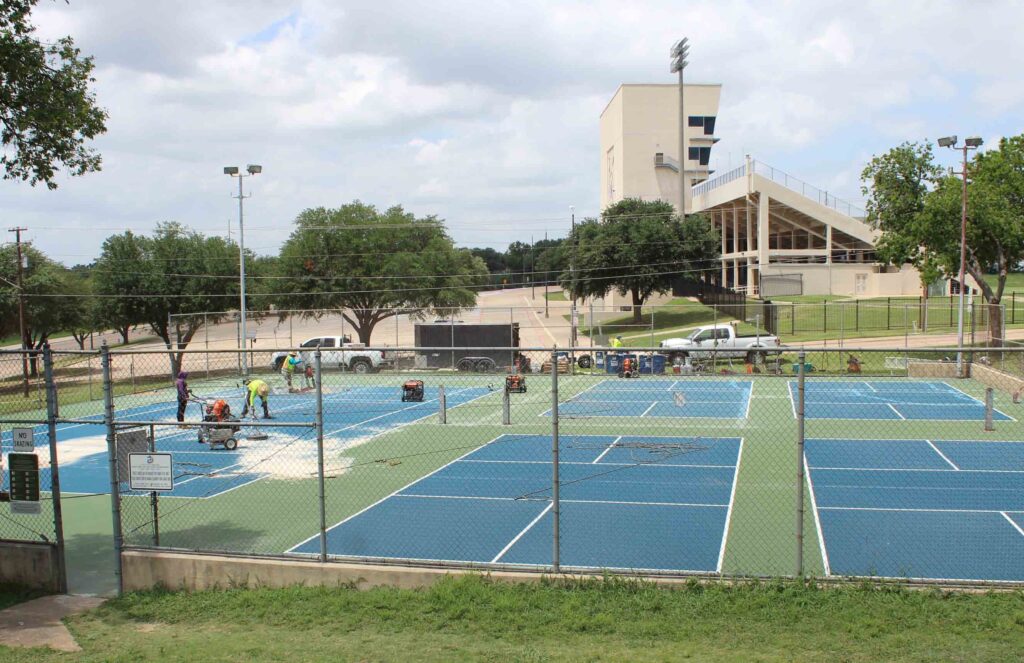
Tennis to pickleball court conversion at Walne Park
Heads up, pickleballers. The Dallas Park and Recreation Department’s initial conversion of one tennis court to four pickleball courts at Walne Park was a rousing success, so they will convert the remaining tennis court to achieve four more pickleball courts this week. Power washing and prepping of the surface began Monday, and all courts will be closed until the project is completed on Saturday, June 13.
Pickleball is a professional sport played worldwide, but its popularity has exploded in recent years. The game was invented in 1965 for children on Bainbridge Island, Washington, and it was named the official sport of Washington State in 2022.
A pickleball court is 20 feet by 44 feet, roughly half the size of a regulation tennis court, and doubles and singles use the same lines. The net is a couple of inches lower than a tennis net, and players use paddles, not rackets, to hit lightweight plastic balls dotted with holes. Directly in front of the net on both sides is a 7-foot non-volley zone known as “the kitchen,” and players may not hit from this box unless the ball has bounced once.
Serves must be underhand and only from the waist in pickleball with contact on the upswing. Drop serves are allowed, but there’s only one shot, so the serve must hit the diagonal crosscourt. Serves alternate between the right and left sides of the court. Games are played to 11 points and won by two, with only the serving team winning points. A ball which hits the baseline or sideline is in.
According to CLNS Media Network, pickleball is the fastest-growing sport in America for the fifth consecutive year. U.S. participation reached 24.3 million players in 2025, and more than 50 million people from 75 countries enjoy the game. First anticipated to be an activity for the older set, the sports’ largest demographic is now the 25-to-34 age group. The average age of a pickleball player has trended downward to 34.8 years old.
The Walne Park pickleball court is lighted and open from 5 a.m. to 10 p.m. daily. Courts are available to the public on a first-come, first-served basis, and play is limited to one game when others are waiting.
