

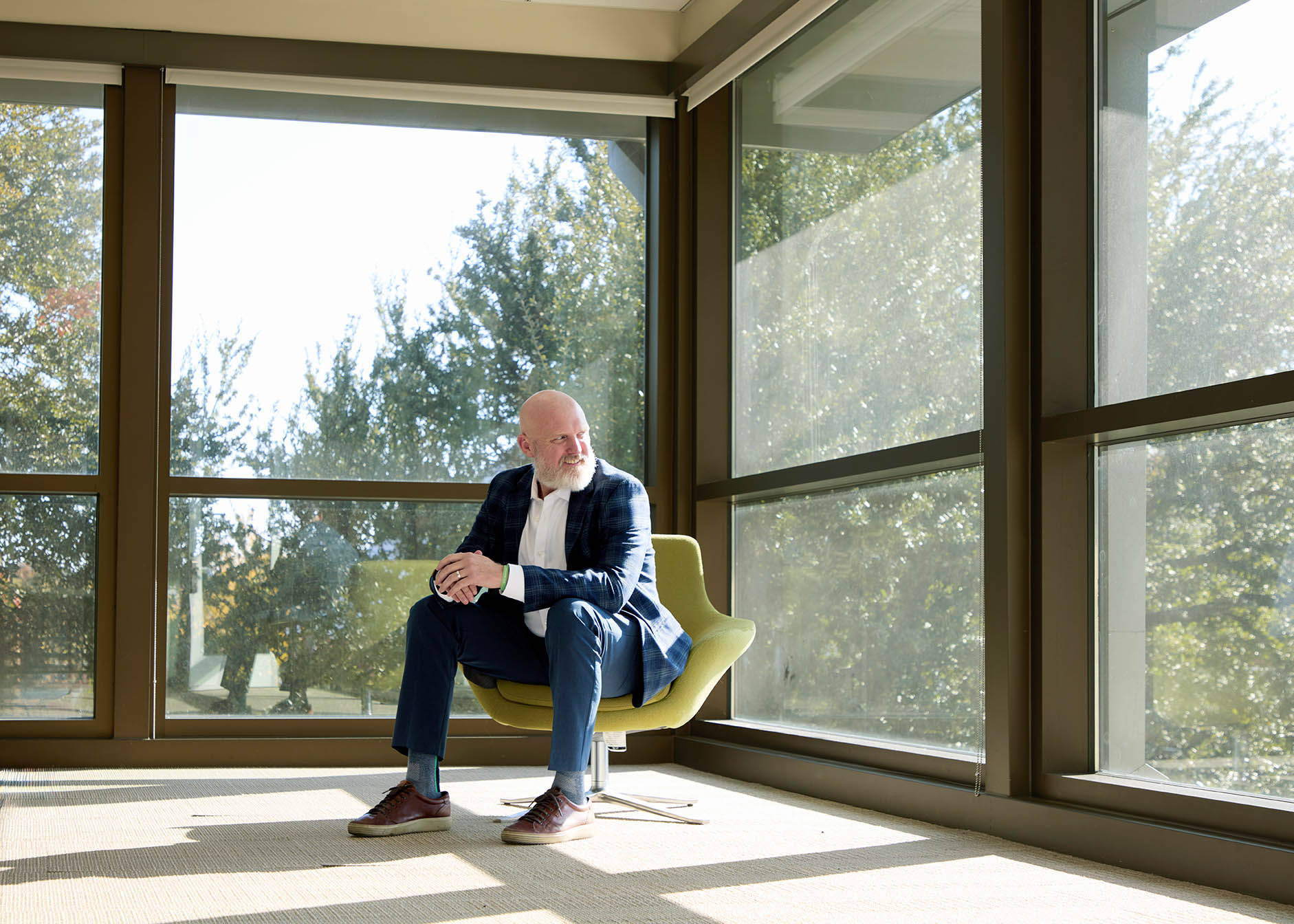
Photography by Victoria Gomez
“I would never think that this can’t happen to my kid.”
That’s the first piece of advice Dallas Court Appointed Special Advocates Public Policy Director Chad Frymire would give to families, followed by being educated about the warning signs.
Frymire knows this lesson all too well. He says he had no idea about human trafficking until his sister was being exploited. She got married and then started acting out of character. He heard that her husband was forcing and manipulating her into extreme acts to make money, and Child Protective Services had to remove her children on separate occasions. Eventually, she passed away.
Getting involved with the North Texas Coalition Against Human Trafficking over a decade ago allowed Frymire to put a name on what his sister was experiencing. The East Dallas neighbor realized that anyone could be a trafficking victim, particularly the vulnerable foster care children who Dallas CASA advocates for. Since then, he has worked to make protecting foster children from human trafficking a priority within CASA.
To that end, Frymire has participated in a handful of local, regional and state anti-trafficking and child protection organizations. In September, he was honored with a 2025 ProtectHER Award from New Friends New Life, the nonprofit that aims to support sex trafficking victims.
Have you always lived in Dallas?
I was born in Albuquerque, and then my family moved to Abilene when I was probably 4 years old. I went to school at Texas Tech. During that time, me and some of the buddies did a couple foreign exchange trips through school. So we studied for a year in The Hague in the Netherlands. We did a semester abroad in Cuernavaca, Mexico, living with a Mexican family and learning Spanish south of Mexico City. Whenever we graduated, we kind of weren’t ready to settle down. So, almost the same crew, we all moved to South Korea, and I spent almost three years there teaching English to young South Korean kids. When I was done with that, I moved to Quito, Ecuador and spent a year there teaching kids English and just kind of traveling around the world, traveling around South America. Then, I went back to Asia and taught a year in Taiwan in Taipei, and so all of that together was almost 9, 10 years of my life that were spent abroad in my 20s. Then when I was 30, I had lived out of a suitcase and a backpack for a decade and was ready to come home. I just chose Dallas, honestly, because I just had old connections here, and it was a familiar place. I did a virtual interview with Big Brothers Big Sisters, worked for them for a couple years, and then I came over here to CASA, and I’ve been here for the last 18.
Tell me about your work with foster children and anti-human trafficking advocacy.
There are a lot of misconceptions. There’s crazy movies about kidnappings by strangers and only happens in big cities and overseas. A lot of people, I think, assume that there’s immediate violence, and kids and girls are physically held captive. But it’s truly not really like that. Most of the time, traffickers use typical child abuse grooming techniques — psychological manipulation, emotional dependence, trust building. They go after kids who are the most vulnerable because that’s the easiest prey for traffickers. If you talk about vulnerable populations and what makes foster kids vulnerable, you’re talking about kids with prior abuse and neglect. You’re talking about homeless youth and youth who run away, which is a big population of our tweens and teens in foster care, low self-esteem, LGBTQ+ communities. Families that might not be accepting and kids go on, run away and then just need financial support and survival. If you think about a kid on the run, especially in foster care, they’ve already been abused and neglected. Their parents aren’t there. They’re part of the system. They have no food. They have no money. They have no transportation. So what’s the one thing that they have that is their bargain chip? Unfortunately, a lot of times, that’s their body. And so that’s what traffickers exploit. They come in as kind of the Romeo and the boyfriend and talk to the kids about how pretty they are there or how horrible their circumstances are and build that relationship, and then, they slowly start turning the screws, making them do more and more progressive things until it can turn into physical violence and threats.
What impact does trafficking have on people from other countries?
A lot of times you have scammers, where they will promise a better life and a better job abroad. Then the trafficker takes their documents. They end up coming over here, working as an indentured servant at an illicit massage business, doing cleaning jobs, landscaping jobs. So it’s not just sex trafficking; it’s also labor. A lot of these folks are from countries where their local governments and police are super corrupt, so they’re already afraid. And then you think about heightened immigration in this particular administration climate. So it just really pushes all of that underground. And it’s just kind of a very lonely, desperate situation when really the only person that’s there for you is your trafficker, or at least, that’s what folks are made to feel.
Since you started focusing on anti-human trafficking, how has CASA changed?
We’re really at the forefront of everything that’s going on in the trafficking world as far as our CASA network. I’ve led the North Texas Coalition Against Human Trafficking for the last decade. Anybody and everybody who’s involved in trafficking work flows through our coalition. It’s very robust. We do a lot of cool stuff. We’re helping design protocols for the World Cup. We’ve got a big, giant project called Engage Together that’s basically a three-year project that’s supported by the Adair Foundation, where it’s bringing all three of the coalitions of the Metroplex together. It’s bringing the North Texas coalition, 5 Stones and C7, all those coalitions together to make a more robust response for anti-trafficking in our area. Every year, we do the Champion of Freedom Award. We’ve been doing that since 2016 to a person or organization that’s deserving of that. We’re all volunteers who run our board, and so we don’t have any development department or anything like that, but we’ve been lucky that community partners and funders have donated money to us. We have two funds that our coalition supports. One of those funds is to help with educational scholarships. One of the biggest things that you can do for a trafficking survivor is help them get educated and become self-sufficient. And on the second hand, we also give emergency funds to survivors. We don’t want a broken down car or one night stay at a hotel or something to set a survivor back and get him or her back into the life. So we’ve really built on our coalition to be something special, and I’m super proud of everything that we’ve done.
This interview has been edited for clarity and brevity.
