

In 2018, on the first day now-District 1 City Council member Chad West was appointed by former council member Scott Griggs to the City Plan and Zoning Commission, there was an announcement about a new development.
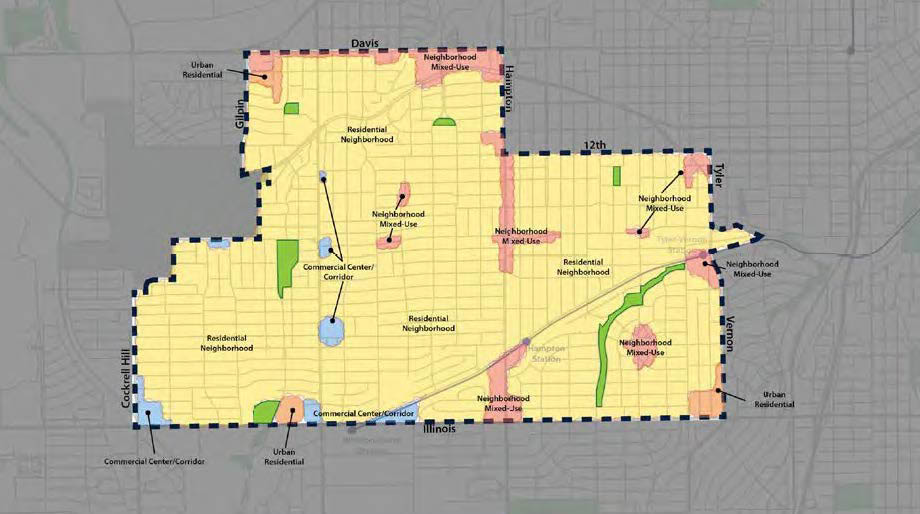
Map courtesy of the City of Dallas.
The 77-year-old building that formerly housed restaurant El Corazon de Tejas would be replaced by a CVS.
“The family sold it, which is their right to do so, and I think did quite well on it,” West says. “But, the neighborhood was not happy about losing that building as a significant Oak Cliff structure and wasn’t also happy about a CVS coming in there with a big parking lot right out front where it’s literally across the street from a streetcar stop.”
To West, a one-story drug store with a parking lot didn’t make sense for the location. He remembers Griggs receiving hundreds of angry emails, calls and letters.
“How could we let that happen?” West says. “Well, that happened there because there wasn’t a zoning overlay in place like we had and still have for Bishop Arts and for Lake Cliff, that kind of area just north of it. So I made a vow to myself, and to Scott and to neighbors, that I was going to do everything I could to not let other little commercial centers like that in Oak Cliff go into the next decade without some kind of planning in place.”
West says the D Magazine article “Bishop Arts Can Be a Model for Southern Dallas Development” by Patrick Kennedy inspired his approach: to use the preservation of streetcar stops as a guide.
CONVERSING ABOUT POTENTIAL CHANGES TO WEST OAK CLIFF
West learned in 2018 that neighbors and property owners of Downtown Elmwood had filed for authorized hearings for a zoning change in that area to specify land use the year prior. He met with local property owners and neighborhood leaders to gather feedback.
He says he joined these meetings to start the conversation widely about balance between development and preservation. That led West to open up other filings for Catherine/Pierce, Hampton/Clarendon, Clarendon/Edgefield and Jimtown, in addition to Elmwood.
Single-family home preservation. Business development. Increased density. That’s what was on neighbors’ minds, West says. These filings laid in the queue leading into the COVID-19 pandemic.
DEVELOPING A NEW AREA PLAN
The Dallas Planning and Urban Design Department changed the priority system for hearing zoning cases as city staff began using WebEx for official business in 2020. Queued filings are now ranked based on a point system to prioritize cases on certain criteria, such as being in a traditionally disenfranchised location, rather than waiting in line based on the filing date.
“The overarching amount of points you could get, that really trumped everything else, was if you had a new area plan … so what did we do? We initiated an area plan process to try to get the points needed so that our cases could get heard,” West says.
Meetings spanned across the community for the new West Oak Cliff Area Plan (WOCAP), from starting online in the summer of 2020.
Yolanda Alameda joined the conversation just prior to that. She heard about the authorized hearing around Polk-Vernon from a Facebook DM learning about the limited communication and community engagement for these proposed changes.
“That’s when we got involved because we said ‘There needs to be community engagement. It needs to be bilingual,’” she says. “It can’t make recommendations for areas that don’t have representation on WOCAP, which was most of what I affectionately call 75211, but it’s all of the area around Martin Weiss Recreation Center.”
While there was translation assistance and Spanish-written slides, lack of access for Spanish speakers at the inception of the process raised concerns. Organizations like Somos Tejas and RAYO Planning stepped in to work with communities to ensure their voices are heard and included in City planning decisions through conversation. In January 2021, a Spanish-language kickoff meeting was added.
Month to month, conversations focused on understanding the community vision to develop WOCAP as a guiding plan, which focuses on rezoning areas in a way that enhances quality of life, walkability and affordability for housing or retail. Informational workshops for understanding land use and zoning and forming neighborhood associations were held.
Alameda says many of those 75211 neighborhoods lacked associations. When the official taskforce was formed to neighbors’ reflect feedback into the area plan, it lacked representation from all neighborhoods.
The early iteration of the taskforce used the Heritage Oak Cliff neighborhood association map as a guide to have representation from each neighborhood, she says.
Initially, the taskforce chair did not live in the area of West Oak Cliff.
“Heritage Oak Cliff is a membership organization, so it only had kind of the older, more established neighborhoods,” Alameda says. “That’s just one example of not really taking time to understand who the residents were, what the communities were, and that noticing that over 70% of it was Latino.”
The task force used a combination of the Heritage Oak Cliff and the city’s Planning and Development maps of neighborhood associations.
When officials learned the Tyler-Polk Neighborhood Association was not in their records, Alameda was added as a representative to the task force. With the formation of three new neighborhood associations during the WOCAP process, their feedback was also incorporated throughout the multi-year process.
Rob Shearer launched the petition “Save West Oak Cliff — Protejamos West Oak Cliff ” on May 24, 2021. He says he started the petition (which gained over 1,000 signatures) to make more people aware of the potential changes coming to their neighborhood.
“It seemed like it was happening disconnected from a lot of the neighbors,” Shearer says. “We wanted to make sure (West) was aware that there were a whole lot of neighbors who had a vested interest in keeping West Oak Cliff affordable, protecting existing neighbors, not rolling out the red carpet for developers so that they could transform an area that really hadn’t been touched by development.”
Shearer says that if WOCAP was meant to be about protecting neighbors, it wouldn’t start with taskforce members of the development community, which the original group did. The taskforce brought the plan to the City Plan Commission in the summer of 2022.
PUT THE BREAKS ON WOCAP
The same year the City Plan and Zoning Commission began to review the area plan, the Automotive Association of Oak Cliff came together.
The auto workers, like Gerardo “Jerry” Figueroa of J & E Express, pushed against the initial call to prohibit new automotive-related businesses from opening on Clarendon Drive. The call for removal of that proposed land use was successful.
According to an editorial published by the Dallas Weekly, testimonies from 30 automotive businesses and supporters at the Comprehensive Land Use Plan Committee meeting on June 14, 2022 put WOCAP under advisement to meet ForwardDallas.
Social media attention also increased the eyes on the area plan. Public comments became filled with increased opposition.
“The City pushes really hard, and they make neighbors’ lives difficult in a sense of having to show up repeatedly on the same issue,” former D1 City Council candidate Giovanni Valderas says. “These people took off work, lost hours because when they don’t work they don’t get paid. And for them to repeatedly show up time and time again, and then to be lectured by city council members, CPC, other appointed officials about ‘You guys keep up the great work showing up and advocating, but we’re still going to vote for this.’”
WOCAP APPROVED
Originally, WOCAP was set to be discussed in August 2022 for the CPC, but large amounts of community concerns during the public comment portion moved the vote.
At the rescheduled date of Sept. 15, 2022, the commission approved 15 amendments to the WOCAP.
In the 184-page draft, recommendations include changes to transportation infrastructure, highlighting increasing housing density, traffic and pedestrian safety enhancements and how neighborhoods can block imposing development they are against.
This plan commission approval brought WOCAP to the City Council on Oct. 26, 2022, where it was adopted and set authorized hearing in motion. Valderas says the passage demoralizes his neighbors who voiced opposition.
“It’s really patronizing,” Valderas says. “And honestly, it pisses people off … why do we keep doing this, if the City continues to do what it wants to do.”
Upon the request of some community activists, the Clarendon/Edgefield authorized hearing was deauthorized, according to West, but the remaining hearings included Downtown Elmwood, North Cliff, Jimtown and Hampton/Clarendon.
“It took so long to get these hearings actually opened up that many of the property owners had sold their properties or moved, couldn’t find them again, at least in the Hampton/Clarendon case,” West says.
But even before all authorized hearings were filed for WOCAP, there had been meetings with all the property owners West could find in these corridors, he says.
The final authorized hearing of the WOCAP, the Hampton/Clarendon rezoning, became a contentious issue in the summer of 2025. Dallas City Council postponed the June 26 vote after most of the 31 registered speakers voiced opposition, according to KERA.
At the rescheduled vote on Aug. 13, the rezoning passed. The decision completed all authorized hearings that took half a decade to receive a vote and came nearly three years after the area plan was approved.
Alameda says she still views the outcome as positive. More neighborhood associations have been formed and have become more active about offering technical assistance to the community when it comes to rezoning.
WHAT’S NEW FOR THE WOCAP POST REZONING
What’s happened since the adoption of WOCAP and the final August rezoning vote? West says nothing.
“This is a blueprint, really, for the next 20 to 50 years for the neighborhood versus something that’s going to happen in the next few years,” he says.
Though another car wash operator and a broker representing a fast food drive thru reached out to West prior to the passage of Hampton/Clarendon, he says he did not support their proposed uses.
While many folks came out to give their input and raise concerns about how the changes could be a land grab for developers to mow out property owners, there hasn’t been evidence for that case, West says.
There is one aspect resulting from WOCAP that Alameda says has not been met.
“One of the biggest asks at the end was asking our council member to form a taskforce to discuss ways to offset displacement, and ways to work with the community and what the city could offer,” she says. “Those are all recommendations in WOCAP that have not been addressed directly.”
Dallas-based developer John Flaim says he discovered Elmwood five or six years ago and added it on his personal list of “cool” places to keep an eye on. Currently, he owns several properties in Dallas, including in The Cedars and West Dallas.
In fall 2024, he came across a long-time vacant parcel located at 2003 S. Edgefield Ave.
Flaim bought the property not knowing any of the debate surrounding the WOCAP. Instead, he just wanted a piece of what he calls a “little oasis.”
Although he currently has no concrete development plans, other than agreeing with the seller not to open a convenience store, he says it should be a gathering place of some sort. He imagines potentially a restaurant or a pickleball center.
“To me, it has to be something that the neighbors need and want,” Flaim says. “And I’m totally open on that, I don’t have a concrete kind of view.”
He says when it comes to pursuing developments in a community, he views it as important to receive the neighborhood input.
“So if you’re not going to make it work for the neighborhood, I mean, to me, that’s just dumb and also kind of suicidal,” Flaim says. “So if you’re not going to make it work for the surrounding residences, it’s just not going to work at all.”
For Valderas, he says with the passage of WOCAP it seems to do just that: ignore the hard work the Latino community put into Oak Cliff for decades.
“What is really heartbreaking for me is we held down the block and this is what we get,” he says. “We get ignored and disrespected.”
Correction/Clarification: A previous version of this article, which appeared in the January print issue, stated that only the Heritage Oak Cliff map of neighborhood associations was used to form the WOCAP task force. This story has been updated with more information regarding the formation of the WOCAP taskforce.
