

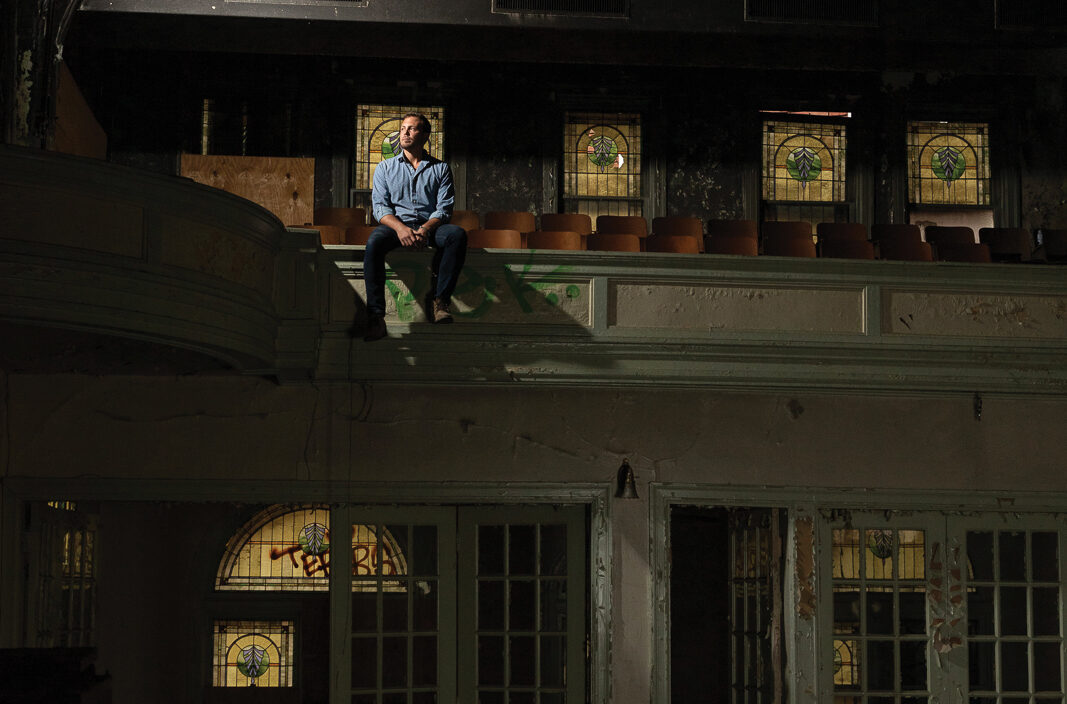
Photography by Victoria Gomez.
Dallas has a history of demolition when it comes to historic properties.
The Oak Cliff Advocate previously reported examples of this demolition across the neighborhood, from the predictions of losing vintage apartments in Bishop Arts to the 35 homes torn down in the Tenth Street Historic District.
However, founder of Proxy Properties AJ Ramler thinks this pattern may be changing. He said the support from the City of Dallas on transforming the former Oak Cliff United Methodist Church into The Jefferson is a tone shift.
“I think they would let you save buildings, but they didn’t support you in saving buildings,” Ramler said. “This is the shift. If they’re going to start supporting us in saving these buildings, it will make buildings like this, that’s sat vacant for 15 years, possible to save again. To me, that’s the tone shift that’s happening. That’s my feeling.”
The Jefferson is requesting up to $10 million in a TIF development agreement. The City Council is set to vote on this request Wednesday, Jan. 14.
The $10 million request is out of a total estimated $19.5 million budget for the property to incorporate flexible workspaces, commercial and retail tenants and 45 multi-family residential units.
The request is not the standard, asking for about 50% of the total estimated costs. The project is also not standard with historic designations requiring specific steps needed to make changes in addition to the demolition-by-neglect state Ramler purchased the property in.
“We’re doing it to the national, the state and the local criteria,” Ramler said. “And it’s very, very intense. The amount of scrutiny that there is on making sure that you’re checking, you’re preserving the construction materials and the way it looks and feels.”
That challenge is part of what excites Ramler for The Jefferson.
“I didn’t expect it to take this long to get us to the starting line, first off,” he said. “But as we learned more about it, we really felt like we needed to take an extra amount. I mean, we always do our best, but try to really drill down, dissect, investigate and research what will work here at this corner because it’s a property that literally, like, most of the people that live in Oak Cliff drive by this property almost every day. I mean, it’s such an important corner. Or at least every week, and I think it represents a part of Oak Cliff that people really appreciate.”
With two community meetings and the likelihood to host one more, Ramler said that the particular feedback from neighbors was the code violation issues surrounding the property and homelessness. Neighbors also shared the desire for potential restaurants, coffee shops and retail in the space.
“It’s asking a lot for these people, these neighbors, to come out and give you feedback on their project, because most of the time, if the developer ever even does take the time to do that, they don’t actually follow through,” he said. “So there’s a lot of empty promises, but I think that if we show up for people over the years, to come spend their evening, talking to you about what the project is, it’s a big sacrifice for them. We’re super grateful always to have that feedback.”
The community-driven aspect of the property is central to help make it a reality, in addition to support from the city as mentioned at last Tuesday’s Economic Development Committee meeting.
“What the City of Dallas is doing here is they’re going above and beyond what is standard,” Ramler said. “That to me, from the City of Dallas, is that they’re interested in preservation.”
