
A lot of digital and actual ink has been spilled about Deep Ellum over the years.
As Madison Partners managing partner Jon Hetzel put it, a Metroplex native’s favorite version of the entertainment district is the one they experienced as young adults. Local musician Ward Richmond likened his first visit to discovering a whole new world.
But the neighborhood has its critics. A Facebook post about a fatal double stabbing near the DART Station garnered comments like, “Uhm, when has Deep Ellum NOT been sketchy,” “I’m glad I got to experience Deep Ellum before it got like this, had some good times over there,” and, “This is why I stay away from Deep Ellum at all cost.” (And yes, others wrote that this area is technically not in the district.)
There are other spots in Dallas known for culture, nightlife and music. And crime happens all over our fair city. Yet, we can’t stop talking about Deep Ellum. There’s something magnetic about those blocks beyond the tracks, and there are rarely neutral opinions to be had.
“I really, truly believe that Deep Ellum is the heart and soul of our city,” Dallas Mayor Pro Tem and District 2 Council member Jesse Moreno says.
Origin story
Black communities (Freedmantown, Stringtown and the Prairie) popped up around Dallas, and men were able to find work around and because of the railroad tracks. William Sidney Pittman, a son of former slaves, designed the Grand Lodge of the Colored Knights of Pythias state headquarters (now The Pittman Hotel), which was completed in 1916 and included offices for Black professionals.
Around that time, Eastern Europeans fled oppression, came to Dallas and started businesses, including plenty of pawnshops. The most famous of these pawnbrokers was “Honest Joe” (aka Rubin Goldstein), who the history book Deep Ellum and Central Track calls a “publicity genius.” He got his name after a “drunken house painter” and customer discouraged a woman from getting a receipt at the shop because, “This is Honest Joe.”
Music made Deep Ellum what it is today. Deep Ellum and Central Track describes Blind Lemon Jefferson as “the most significant blues singer to perform in Deep Ellum” by the time he died in 1929. Jefferson met fellow musician Huddie Ledbetter (aka “Lead Belly”), and the two of them played together. Henry “Buster” Smith, Willard “Ramblin’” Thomas, Blind Willie Johnson, Alex Moore, Marvin “Smokey” Montgomery and others shaped the music scene for blues, jazz and related subgenres.
As Deep Ellum’s music scene has a long history, so does its reputation for being seedy.
“Some television person asked me, ‘What do you think about Deep Ellum’s bad reputation?’ And I just laughed,” says Frank Campagna, prolific Deep Ellum muralist and Kettle Art Gallery founder, in an interview last year. “It’s had a bad reputation since it started, which used to be good because it would keep the riffraff out, but now, it’s not good.”
Alcohol was flowing both during and after Prohibition, and marijuana was “sold by the stick” in the 1940s. When elected district attorney in 1946, Will Wilson took a stance against organized crime, specifically against gambling boss Benny Binion, but that didn’t fully end gambling. Sex work was part of the neighborhood’s economy, but that was all of Dallas, according to Deep Ellum and Central Track.
As those in Deep Ellum today know, a reputation for bad behavior sticks like glue, even when it’s not exactly fair. (And considering the neighborhood was occupied by Black people and immigrants, racism could have shaped early narratives about the neighborhood.)
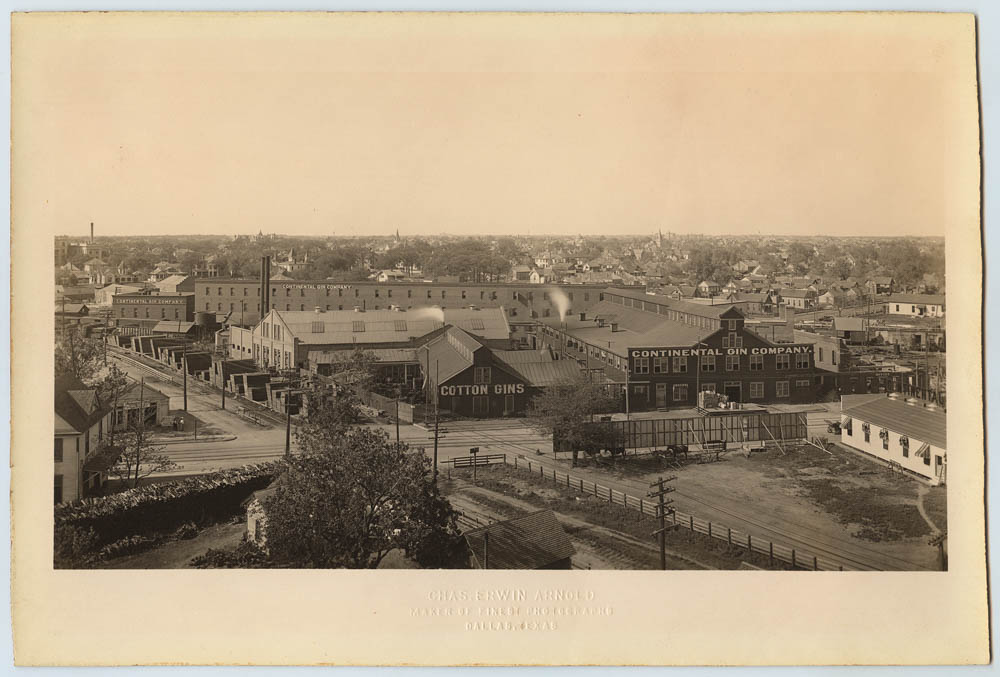
Continental Gin Company on Elm Street
Blast to the present: that sentiment was echoed by nightclub and bar worker Sloane, who spoke to the Lakewood/East Dallas Advocate last year.
“I’m down here six days a week for eight, nine, 10 hours of time, and I rarely see an issue,” Sloane says. “It’s nowhere near as bad as people have made it out to be, and then because of that, people won’t come down here.”
Put differently by Hetzel: “Stories about crime in Deep Ellum are more interesting than stories about crime in other parts of the city, particularly areas that routinely have crime that a lot of readers don’t care as much about. And I get that. But we almost never escape notice on anything happening down here.”
Moreno says Deep Ellum is not more dangerous than other nightlife areas in Dallas, but it should only be compared to other entertainment districts.
Then again, last summer was cruel. Three people were killed in Deep Ellum, and that resulted in expanded nighttime vehicular street closures.
Moreno, who is also vice chairperson on the council’s Public Safety Committee, ushered in the first dedicated police unit for a single community in Deep Ellum. Because of its success, he expects this strategy to be replicated in other areas of the city. But the police presence shouldn’t feel overwhelming and should be balanced with other security measures.
After the bar Rodeo Dallas closed, crime dropped by nearly 30%, Moreno says.
Rodeo was pulled into legal drama by its landlord Westdale and neighboring property owner Asana Partners last year. Rodeo’s owner rebutted claims that the bar was contributing to crime in Deep Ellum and accused property and development firms of trying to get rid of Black and Hispanic patrons.
Moreno says businesses have to be accountable for what happens in their establishments and how that contributes to violent crime.
“There were a lot of allegations that we were trying to wash Deep Ellum, and we were going after establishments that played a certain kind of music,” he says. “Well, guess what? That’s the type of music that I love. So it’s definitely not that we’re trying to shut down people that are playing hip hop or venues that are playing rap music. I believe it comes to the business practices such as overserving, allowing minors in, not having de-escalation policies in place. As a business owner, that’s your responsibility.”
Ups and downs
Shifts in Deep Ellum are apparent not by crime rates alone, but by the number of businesses open.
In the mid-20th century, Central Expressway replaced the railroads that birthed Deep Ellum in 1873.
“Development changed the neighborhood,” says Alan Govenar, co-author of Deep Ellum and Central Track. “After the Great Depression and during the Great Depression, the 1930s, Deep Ellum declined, and then by the 1940s and ’50s and ’60s, ’70s, it became a warehouse district.”
Madison Partners came into the picture in the late 1970s and early 1980s. Owner Susan Reese and her husband were buying property in “neglected areas,” which included Deep Ellum, Hetzel says. This was at the peak of “white flight,” in which white people left urban areas for the suburbs. As a result, pictures of Deep Ellum from that era show “grass lots, falling down buildings, tumbleweeds.”
This is the environment that led to a revival as a punk rock music scene in the 1980s.
“It was people like Jeff Swaney and Mark Cuban and Russell Hobbs, these people who decided to start these nightclubs where they would bring shows in,” Deep Ellum Foundation Archive Manager Cathryn Colcer says. “And it was at Theatre Gallery that they brought in the Red Hot Chili Peppers back then. They played here in the neighborhood when they were just getting started.”
So Deep Ellum embraced punk music. Great! But this also coincided with the presence of racist skinheads (though some were reportedly anti-racist), who were linked with incidents of violence and harassment. Not great. Dallas was a microcosm of a trend happening nationally.
Yet, that wasn’t everyone’s experience. In the ’90s, Reno’s Chop Shop co-owner Amber Haldiman remembers being welcomed and accepted.
“I never really fit in anywhere until I came here, and then, it made sense that we can all be different, and that’s OK,” Haldiman says.
The skinhead period seemingly peaked when a man was brutally attacked by someone with ties to the notorious Confederate Hammerskins in 2004 at the former Gypsy Tea Room. The district went quiet afterwards.
“When I moved back to Dallas in 2008, Deep Ellum was dead,” Colcer says, adding that the Great Recession likely played a role in the decline. “There were ‘for lease’ signs on almost every building.”
Mike Ziemer, who founded Third String Entertainment and opened the music venue Puzzles last year with Orlando Mendoza, remembers this drought, too. They were music promoters, and the vacancies affected their work over a decade ago.
“All these places had gone under, and we weren’t doing too much booking down here at that point, but we were wanting to,” Ziemer says. “We just kind of both have the same vision of not letting Deep Ellum get to that point again where there’s just endless empty buildings.”
Gradually, a few of district’s most noteworthy restaurants opened — Twisted Root Burger Co. in 2006, Cane Rosso in 2011 and Pecan Lodge in 2014. Hetzel called the district an “incubator neighborhood” for innovative businesses.
Around 2012, zoning changes allowed adding more apartments and office spaces to be developed, moving away from the perception that Deep Ellum is only for nightlife, Hetzel says. The changes also aimed to prevent old buildings from being turned into parking lots.
“What that’s done is it’s allowed our old building stock to be almost entirely activated,” he says. “It also encourages people to take an Uber if they’re going to spend a night out going to dinner and drinking.”
As the Deep Ellum Foundation Executive Director, Stephanie Keller Hudiburg is the face of the district. The nonprofit foundation manages the Deep Ellum Public Improvement District, created in 1999.
When Hudiburg joined the foundation in 2018, the neighborhood was booming. The Dallas Morning News declared it was “reborn,” as patrons packed into bars and restaurants and filled up the sidewalks and streets.
Enter the COVID-19 pandemic, one of the biggest villains of the 21st century so far. Telling Deep Ellum to stop hosting in-person experiences for people is “not what this neighborhood specializes in,” Hudiburg says.
The days of Dallasites wearing masks and social distancing are gone, but when asked if the pandemic still has lingering effects, Hudiburg says, “100%.”
“If you ask people that have come down here post-COVID, they’ll describe what a busy night looks like. It is different than what a person who was here before says a busy night was like,” she says. “Back in 2018, 2019, at a certain time of night, it would be hard to walk down the sidewalk, there were so many people. You’d just have to kind of navigate slowly. And that still happens on occasion, but it’s not like it was, so that volume, it’s relative.”
Moreno has a different perspective. Thanks to accommodating landlords and the true grit of business owners, it fared better than most during the pandemic, he says.
“One of my priorities was I don’t want to see Deep Ellum boarded up the way I saw it as a teenager,” he says. “I’m happy to say during COVID, Deep Ellum was one of the few places that actually attracted more businesses than actually shut down. A lot of people don’t know that, but during COVID, Deep Ellum was extremely successful.”
So what’s happening now?
Small business blues
Business was slow at almost 7 p.m. Friday at Reno’s in August. The bartender served drinks to a few customers, and two guys played pool. A group of friends in the nearly empty parking lot next to Reno’s asked which streets are closing because they’re afraid that their car will get locked in. One of them remarks that the lot is usually full by now.
“This would be packed,” Reno’s regular Manda says about the bar.
Haldiman acknowledged then that the street closures hurt Deep Ellum businesses by cutting off parking, ergo limiting much-needed support from patrons.
Reno’s has been open for over 21 years. Haldiman has worked at the heavy metal bar for many years, and she and her husband Steve bought it over 5 years ago to prevent it being turned into a sports bar.
Manda hasn’t been around for a relatively long time, but she quickly found a community at Reno’s. She went out of her way to buy a fan for the patio when she noticed the old one broke. And when her mother was in the ICU, people at Reno’s checked in on her.
“I love this bar, and they love me,” she says. “They take care of me and look out for me.”
Campagna recognizes the beauty of the community, too. When a leak flooded Kettle Art Gallery, he didn’t deal with it alone.
“People from all over the neighborhood came by to help clean up and straighten it up, and within 24 hours, we were ready for our next event,” he says.
Supporting the neighborhood isn’t about making tons of money, Haldiman says. She wants to ensure that the community and culture that was forged by its early inhabitants stays intact.
“There’s a lot of people that are so talented here, and if we can keep this community going, I think the talent that we’ll see come out of here will be to our (society in general’s) benefit,” she says, referring to Deep Ellum’s artists especially.
Still, establishments can’t survive on good vibes alone. Places like Reno’s still need people to come out and buy drinks.
“I think if there’s not an intentionality in investing in what’s made it special in the first place, in patronizing our small businesses, those things are not guaranteed,” says Hudiburg, while ironically sitting in the now closed Dot’s Hop House and Cocktail Courtyard. “Some of these places have been here for 30 years, but it matters to them, like month over month, if the customers are coming in or not.”
Campagna recalled admiring new businesses on Main Street before realizing that they would probably see more success outside of Deep Ellum.
“We’ve got all this really great stuff going on, and it’s a good solid block, and if you pick that up and put it anywhere else in Dallas, it would be booming,” he says.
The future
The Deep Ellum Foundation has been working with the City and community on developing an updated safety plan with “new policies, national best practices and local solutions to address the neighborhood’s current needs,” Hudiburg says. The original plan from 2022 was effective in reducing crime.
Street closures are working, Moreno says, so they will stay in place for the foreseeable future. But they may evolve based on what the needs are, and the locations and hours of the closures need to be more consistent and well communicated.
Hudiburg says the foundation is also working on a plan for infrastructure improvements, like lighting on Malcolm X Boulevard, adding parking and making Crowdus Street more pedestrian friendly. She even mentioned the idea of getting a trolley to transport people from parking lots on the periphery into the core.
Commerce Street construction, which will turn it into a two-way road and improve sidewalks and drainage, isn’t expected to be done until early next year. Businesses have reportedly been struggling in the meantime, but Moreno says this project was approved by voters in a previous City bond program.
“We’re going to have better pedestrian access, we’re going to have better streetscape, and it’s going to be more inviting,” he says. “For those businesses that are able to make it through the heartaches, I know their sales are going to be up. I know they’re going to have tremendous success. Yes, construction sucks. We wish that it didn’t have to happen, but construction is a sign of progress.”
With all the highs and lows, it makes sense that Hudiburg would compare the district to the mythical phoenix that continually burns out and is reborn from ashes.
“You can’t keep Deep Ellum down,” she says.
If you could choose a song that embodied Deep Ellum’s spirit, reader, consider Houston rapper Megan Thee Stallion’s “Her.” Why? This line specifically: “No matter what they say or do, it ain’t no gettin’ rid of me.”
Deep Ellum is here to stay.
“This isn’t a neighborhood that’s just going downhill,” Haldiman says. “There’s a lot of feet on the ground that are actively working day and night to bring back the best entertainment district, in my opinion, in Texas.”
