

Dallas City Council members voiced concerns at a Special Called Transportation and Infrastructure Committee meeting last month about the proposed options to change the current connection of the Jefferson Boulevard Viaduct to Downtown.
During the March 23 meeting, city staff briefed the council members in attendance about a structural conflict between the viaduct and the planned upgrades to the Kay Bailey Hutchinson Convention Center.
“Originally, when we designed the building, it was going to allow for the viaduct to go under the building, for traffic to flow under the building,” Rosa Fleming, the executive director of Convention and Event Services for the City of Dallas, said at the committee meeting. “We briefed that last year and were then asked to lower the cost of the building. And the lowering of the cost to the building, we took it down two stories, and in doing that, had to reprogram it.”
For the $3.5 billion total cost expected for the convention center, the lowering of the building will save $500 million, but also block the current path of the Jefferson Viaduct. Now, some of the coordination that has to be done is with the results of the Oak Farms Corridor Study, Fleming said.
In the fall, the Department of Transportation and Public Works presented the findings of the Oak Cliff Farms Transportation Study. The study included two components: one from the City of Dallas and one from the North Central Texas Council of Governments (NCTCOG), director of the Department of Transportation and Public Works Gus Khankarli said at a Feb. 17 community meeting about the study.
For the City of Dallas component, the study looked at the infrastructure of the roadways that connects into the former Oak Farms site to be developed for economic opportunities. As for the NCTCG component, the focus was connectivity, especially between the freeways and the two main roadways of the Jefferson and Houston Viaducts.
At the February meeting, the presentation included plans to convert the Houston Street Viaduct into a pedestrian bridge with a streetcar path and then move car transportation strictly on to the Jefferson Viaduct with two lanes southbound and two lanes northbound.
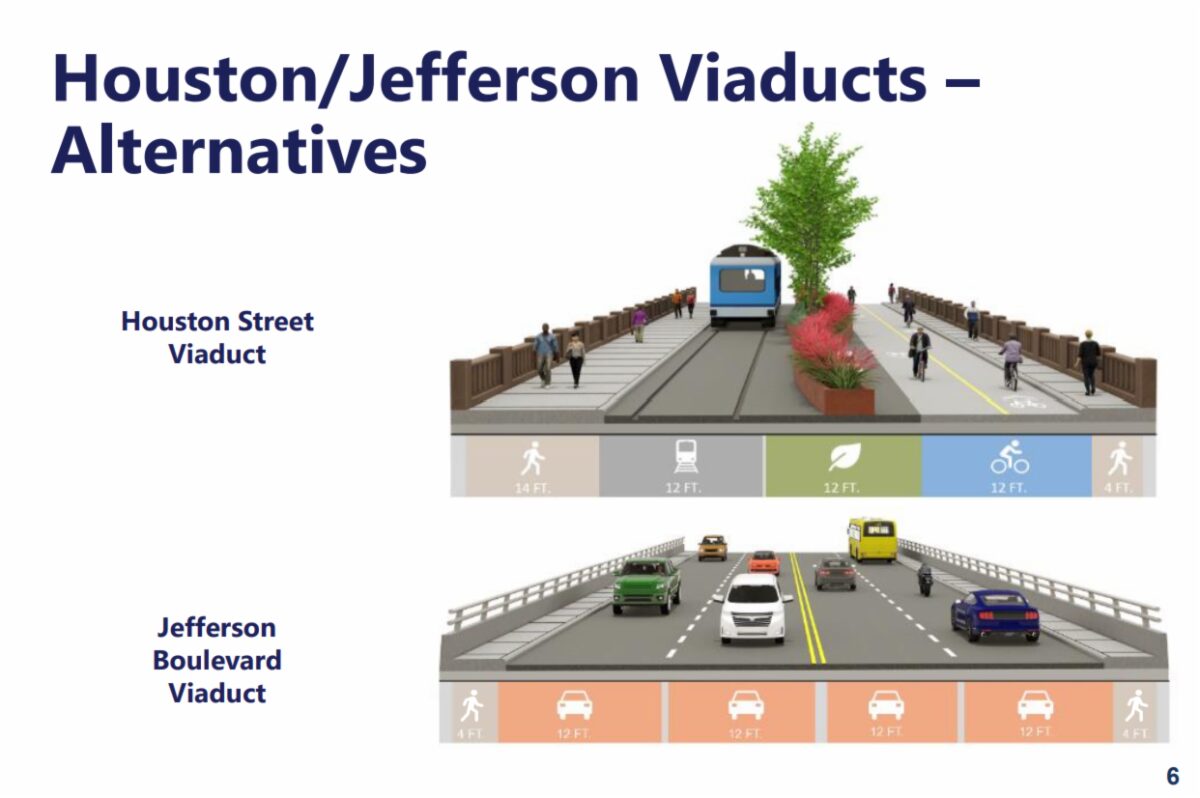
Courtesy of the City of Dallas.
“Even before the convention center discussion started, the Council of Governments had met with community members as part of the Oak Farms Corridor Study and Houston has been discussed for, since before my time actually, as a pedestrian bike bridge with Jefferson getting all the traffic,” District 1 Council member Chad West said at the committee meeting. “So the community has already spoken on that. They’re very supportive of a plan to somehow get bikes, pedestrians into Downtown in a safe manner because it’s not right now … I would hate to see that compromised in any way.”
With the change in the convention center expansion plans, the output point of the Jefferson Viaduct into Downtown is not yet finalized.
“All of that had to be addressed anyway, but the interaction with how we interact with the viaduct arose partially because of the retooling of the building,” Fleming said.
Three potential options were presented to the committee to address the convention center design conflicting with the current viaduct: connect Jefferson to Hotel Street, Jefferson goes through the center’s underpass to the Ceremonial Drive, or Jefferson merges with Houston with an additional down ramp to Hotel Street.
The proposed recommendation from city staff is to reroute the traffic to and from Oak Cliff around the convention center, connecting Jefferson to Hotel Street.
“There’s not an easy solution. I would like to see some more work done, and I would like to see you guys come back here to … tell us what you find when you’ve worked through the issues with the stakeholders,” West said at the committee meeting.
District 14 Council member and chair of the committee, Paul Ridley, said that staff should return to the April 20 committee meeting with additional options and traffic studies.
In an April 7 memo to City Manager Kimberly Bizor Tolbert from West and District 4 Council member Maxie Johnson, the council members requested that city staff collaborate with the North Central Texas Council of Governments on the viaduct realignment.
Additionally, the memo requested that before the next Transportation and Infrastructure Committee meeting, both departments co-host a virtual public community meeting in coordination with the council members’ offices to ensure residents understand the alternatives being considered and can weigh in on the infrastructure change.
