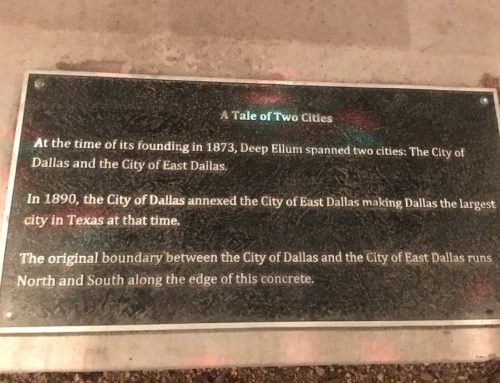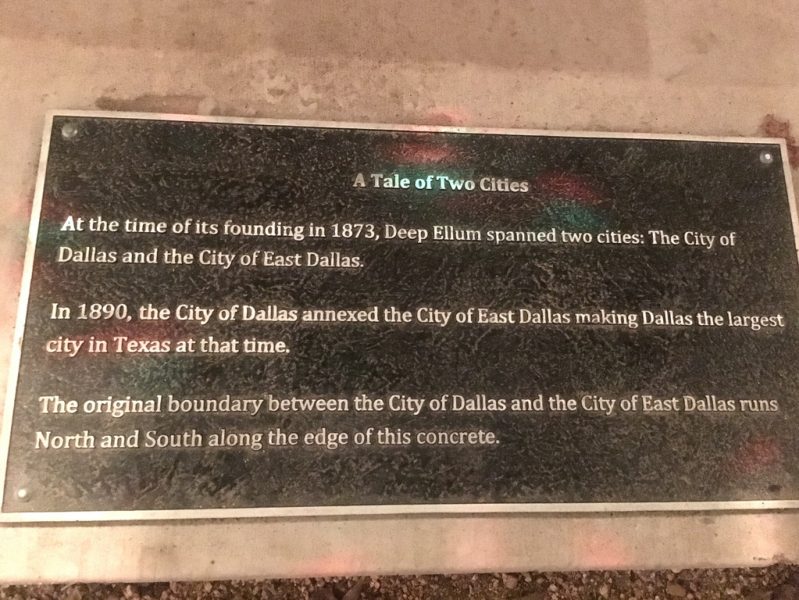

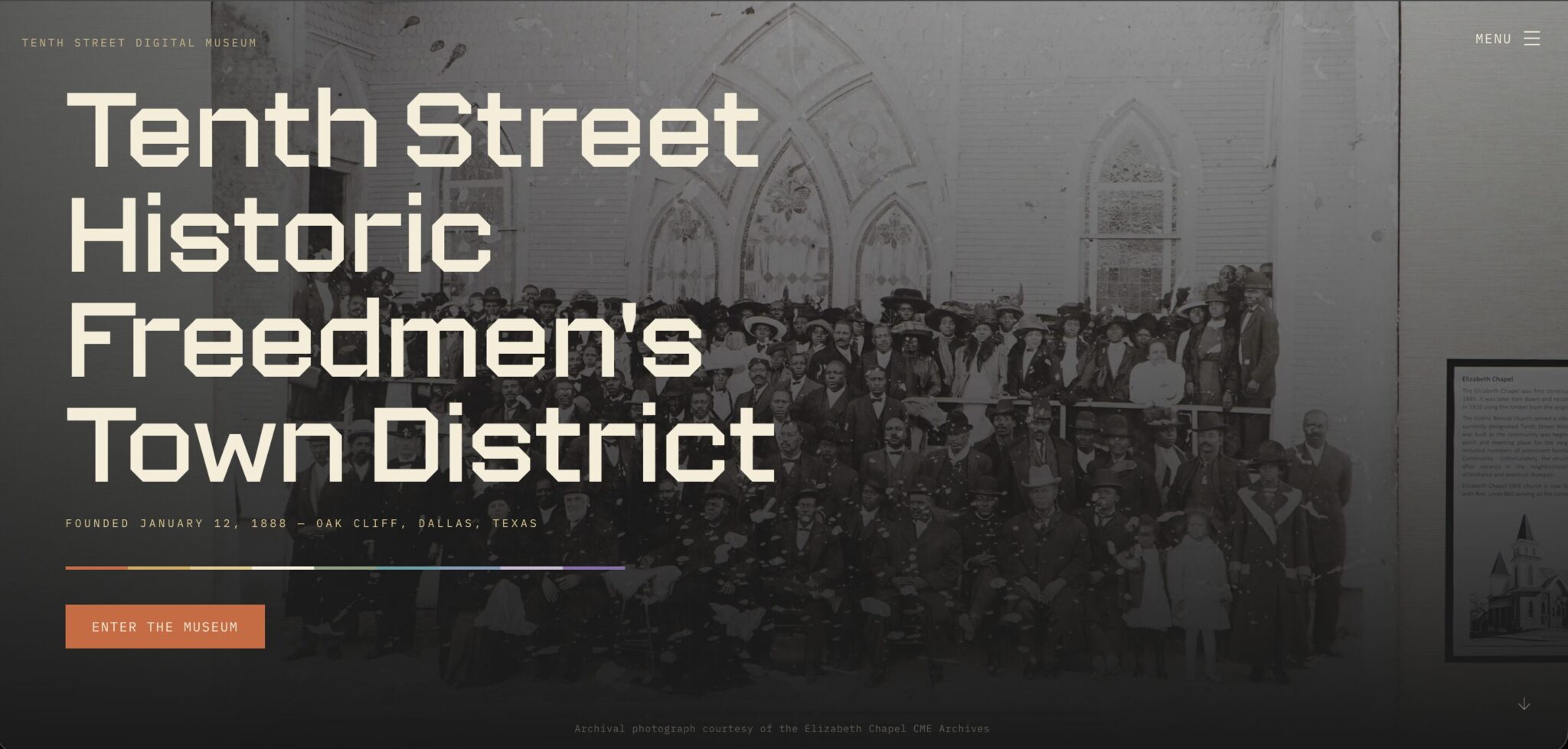
The entry to the Tenth Street Digital Museum introduces the Tenth Street Historic District in Dallas, widely regarded as the nation’s most intact Freedmen’s Town; museum design and development by kinkofa.
Five years ago, Tameshia Rudd-Ridge went looking for one of her family member’s childhood homes in the Tenth Street Historic District. Instead, she discovered part of the highway where that home was supposed to be.
Now, what started as family history research has grown into a collection recently published by the Library of Congress and the Tenth Street Digital Museum, which launches Wednesday, April 15.
Rudd-Ridge and her cousin, Jourdan Brunson, are the co-founders of kinkofa, a tech company that provides resources for Black families to document, share and preserve their stories.
One of the company’s umbrella projects is If Tenth Street Could Talk, a community-engaged initiative that follows both descendants and residents of the Tenth Street Historic District to preserve the legacy of one of the largest remaining Freedman’s Towns in the United States.
As recipients of a 2023 American Folklife Center Community Collections Grant from the Library of Congress’s Of the People: Widening Path initiative, the collaboration between kinkofa and Remembering Black Dallas compiled nearly 500 artifacts to submit to the collection.
“The collection brings to the Library of Congress – and, in turn, audiences in Dallas, and across the country and world – not only a crucial resource for learning the history of Oak Cliff Freedmen’s Town, but also a model for community-led historic preservation efforts,” Michelle Stefano, a folklife specialist in research and programs at the American Folklife Center, said in a statement. “Indeed, through collection interviews, photographs, videos, and maps, a story is thoughtfully woven together that traces, over decades through today, the remarkable efforts of community leaders, residents, and their descendants to protect the Tenth Street Historic District, and to continue to raise needed awareness of its significance for so many.”
Opening the collection, the home page gives an overview of the project as well as some information about community history, Brunson said. From there, you can navigate to featured content or the drop-down menu to view sections of collection items or articles and essays on the project.
Some of the materials are organized by event, like a video from the grand opening of the Tenth Street Neighborhood Resource Center, whereas others document sit-down interviews conducted by Brunson and Rudd-Ridge.
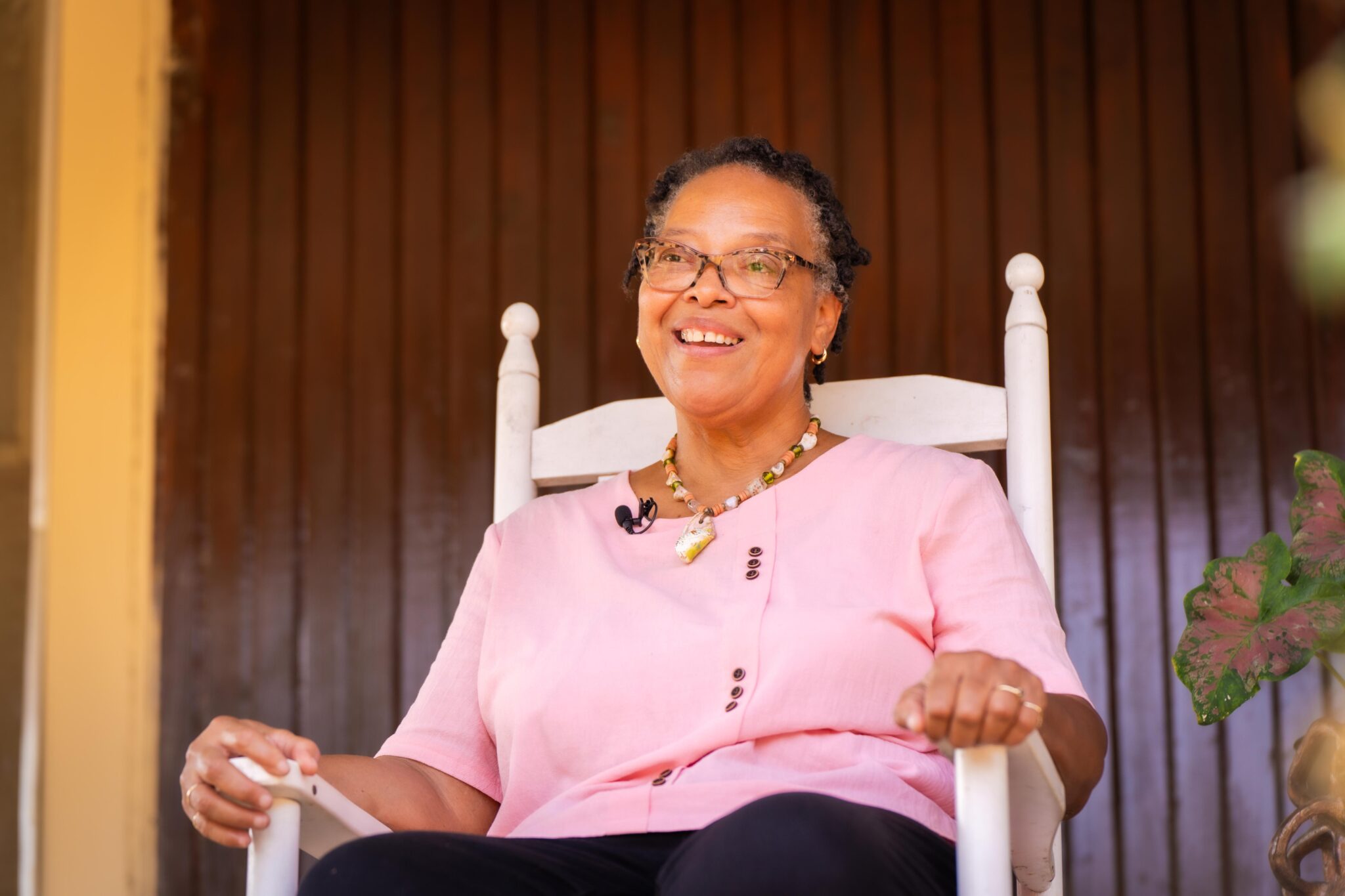
Artist and descendant Lou Nell Sims, photographed in the Tenth Street Historic District, reflects on her family’s business, Sims Cleaners, and the impact of highway construction and other development on the community. “Lou Nell Sims interview conducted by Jourdan Brunson & Tameshia Rudd-Ridge,” via Tenth Street Historic District and The Bottom in Dallas’s Oak Cliff Freedmen’s Town: Community Collections Grant Project, courtesy of the Library of Congress.
One of the featured items in the collection was when kinkofa worked with local students through the Emerging Historians Summer Field School program.
“This was a field school that we hosted in summer 2023 with high school and college students so that we could upskill some youth who are interested in storytelling and essentially doing the type of work that our team was conducting on the If Tenth Street Could Talk project,” Brunson said. “So things like oral history interviews, exploring the archives and what you can do with archival content, discovering histories of Black Dallas, so that, again, they could both gain the skills, but also the contextual knowledge.”
Working with young people is something that they felt was really important, Rudd-Ridge said.
“A lot of times, people think you have to leave Dallas in order to do cool things, and this gives them a set of skills that they can use,” she said. “Whether they choose to go into archives or whatever, it’s just really empowering young people to be authors of our history.”
Another impactful aspect of the collection and its publication is having something that formalizes the work that local community members have done and means that Dallas, specifically Black Dallas, is “finally acknowledged,” Rudd-Ridge said.
“And (that’s) something that we reflect on with our collection is that had Dr. Mamie McKnight, a descendant of the community, not taken up the mantle and work to get the Landmark District approval and the National Historic Register approval, we wouldn’t be here today, right, like the community would probably have faced the similar fate of other communities in Dallas, but that had protected it,” she said.
With the Library of Congress collection, kinkofa was specifically creating new archival material, Rudd-Ridge said.
“Our goal was to document what was happening as it was happening for that part of the archival record, but that also remains stagnant,” she said. “Our work in Tenth Street is ongoing, just like our research of families and different activities going on, and so the digital museum allows us to continue to add, and for it to be a living archive, and to bring together fragmented archival items that are in different repositories all over the U.S. and all over the world, really.”
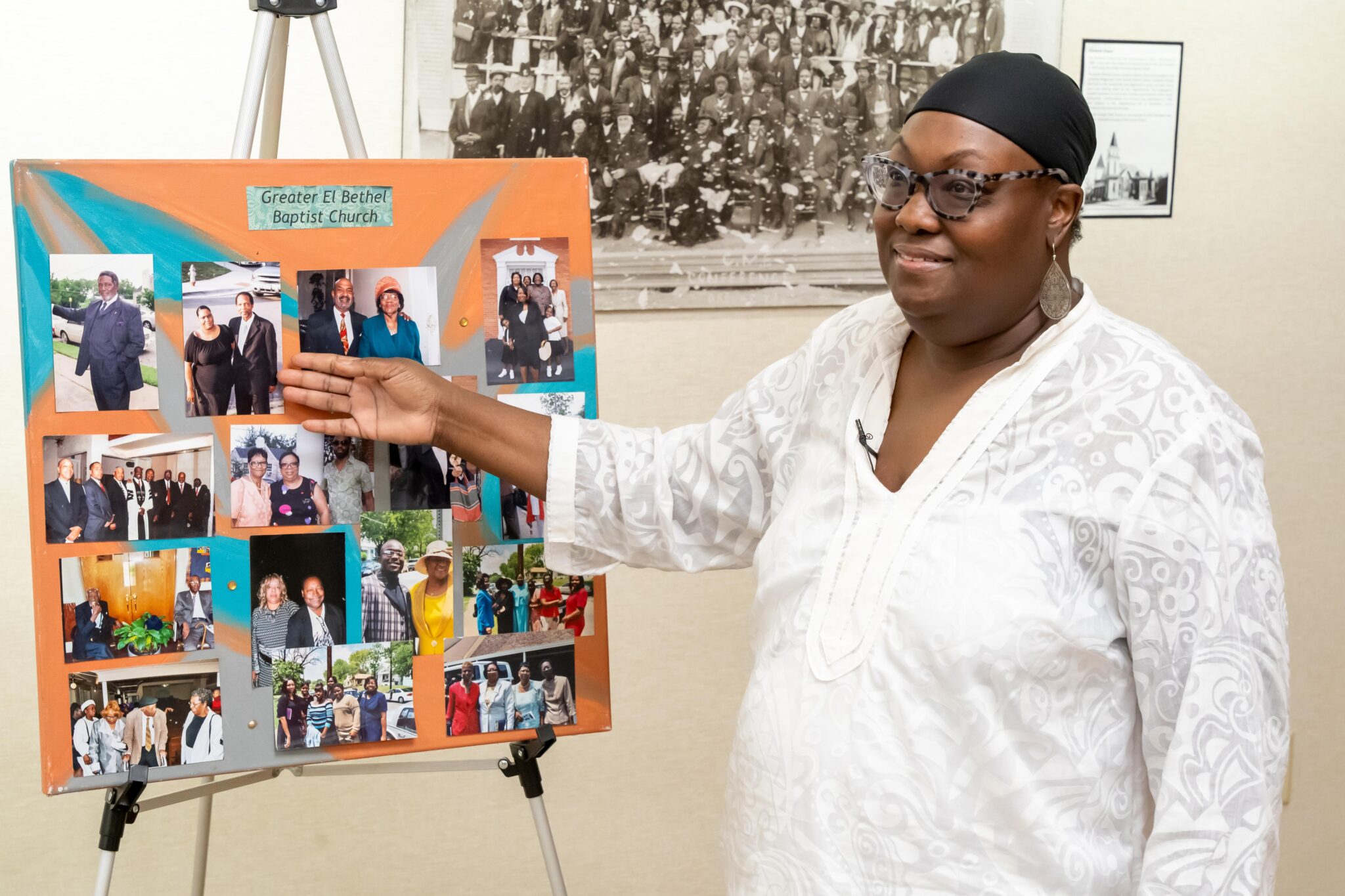
At a Juneteenth 2023 exhibition, descendant and resident Shaun Montgomery presents a community-curated display on the Tenth Street Historic District, highlighting Greater El Bethel Missionary Baptist Church, where she has been a lifelong member. “Shaun Montgomery interview conducted by Jourdan Brunson and Tameshia Rudd-Ridge,” via Tenth Street Historic District and The Bottom in Dallas’s Oak Cliff Freedmen’s Town: Community Collections Grant Project, courtesy of the Library of Congress.
The Tenth Street Digital Museum includes items that could not be submitted to the final Library of Congress collection. Its exhibits will continue to develop with additional material covering the back story of Tenth Street, the foundational families, an overview of the neighborhood’s contributing structures and significant places, businesses, occupations, commerce, spiritual life, education and social life.
Some exhibits have interactive sections, such as dragging your cursor to change the year of the Then & Now map to view highway construction and contributing structures within the district over time, or clicking to view the full profiles of the individuals listed in the Wall of Respect that have made impacts both locally and around the globe.
“These are people that either we found in our research, descendants and residents and community advocates (that) surfaced. And so they’re here, and you can go in and read about them. So if you go to Noah Penn, you learn where he was born. This is transcriptions from archival records that we found,” Rudd-Ridge said, describing the Wall of Respect exhibit.
The design aspects of the digital museum are very intentional, specifically inspired by the work of W.E.B. Du Bois. Even the font used was created by a Black designer who named the typeface “Du Bois.”
Colors used throughout the website are also inspired by former Tenth Street homes based on the way that community members described seeing them, she said.
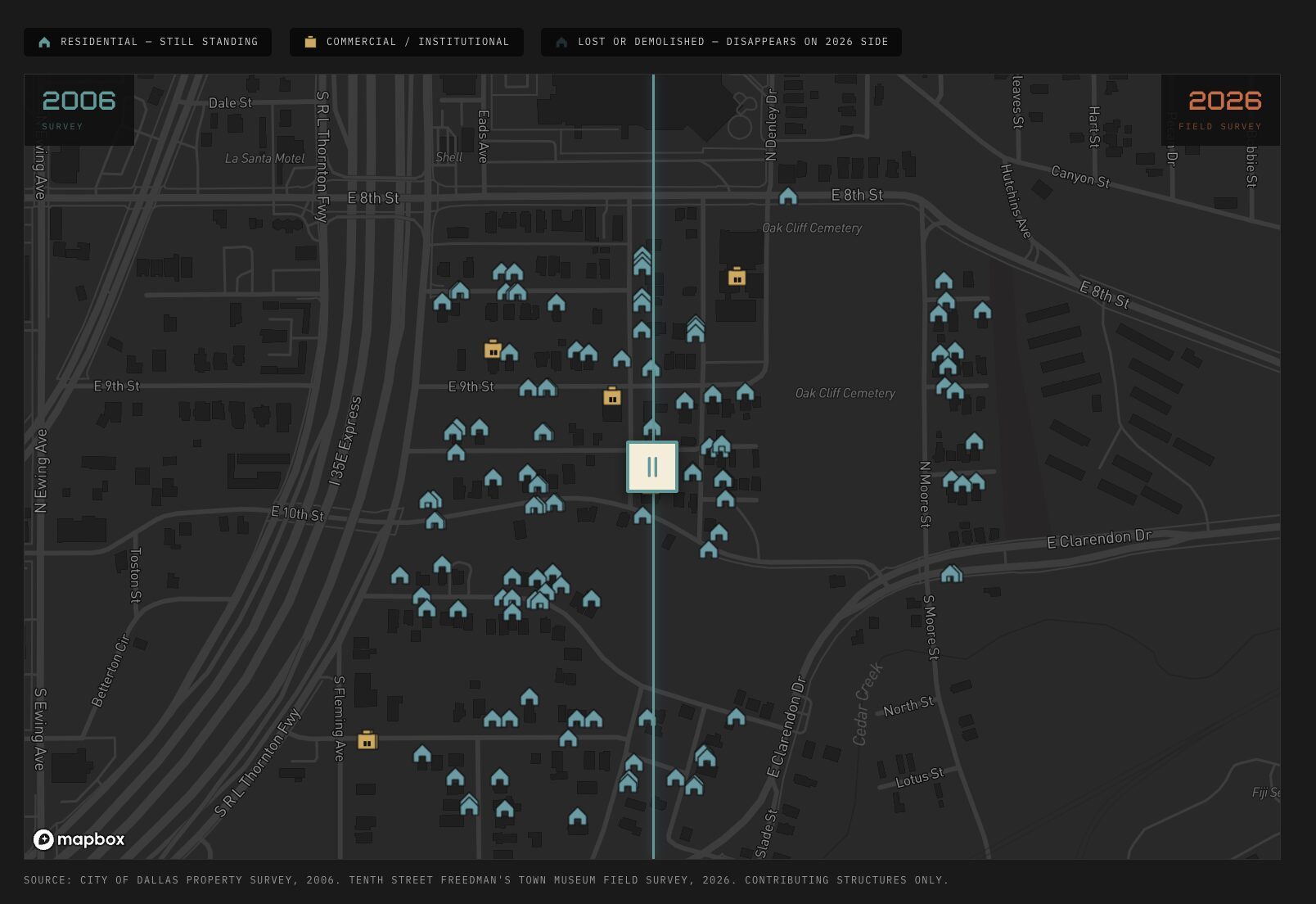
Preview from the Tenth Street Digital Museum compares how many historic homes and buildings have been lost over 20 years in the Tenth Street Historic District; map and survey by kinkofa as part of If Tenth Street Could Talk.
With the digital museum and collection years in the making, Rudd-Ridge said she almost can’t believe the moment is finally here.
“For me, this is something that people worldwide can find, both at our website and at the Library of Congress,” she said, “and so for me it’s just both bittersweet and probably one of the greatest feelings I’ve ever felt on Earth.”
Rudd-Ridge added that the moment is especially important as a descendant.
“I think for me as a descendant of a lot of Dallas’s Black Freedman’s Towns, it means that my family is finally recognized as part of American history in different ways,” she said, “and the people, our neighbors and community members and friends, all the things are also now getting their just due.”
Brunson said as someone who doesn’t know that they descend from Tenth Street, and as someone who’s not from Dallas, it gives him hope.
“I think learning about Tenth Street and being able to be a part of documenting its history have created an attachment that I have, that I would also have, even if I didn’t work on this project. As someone who cares about where my history lives and the connections that I have to communities, I think it gives me the possibility of one day discovering some unique connection … whether it’s maybe someone that I’m connected to performed in Tenth Street or played in the Dallas Black Giants.”
Brunson added that one connection he did find was a street named Stampley, a name he has found in his ancestry. That discovery has given him an additional personal reason to care and find out what the possible connection could be.
Another aspect Brunson is reflecting on with the release is the anticipation from community members about the work.
“They have told us they’re excited about the launch of the collection, excited for the museum to come since we’ve interviewed them pretty much,” he said, “and so I’m really glad that they’ll have a moment, or not a moment, but they’ll be able to celebrate and share something that they’re part of, and again, hopefully create more attention and advocacy for the community.”
To take a look at the Library of Congress collection, click here.
To visit the Tenth Street Digital Museum, which launches Wednesday, April 15, visit tenthstreethistoricdistrict.com.