

The first floor of Lloyd Keyser’s Lake Highlands home is like most others in the neighborhood, with a dining room, kitchen and study. Climb the stairs to the second floor, though, and you’ll be stepping into another world.
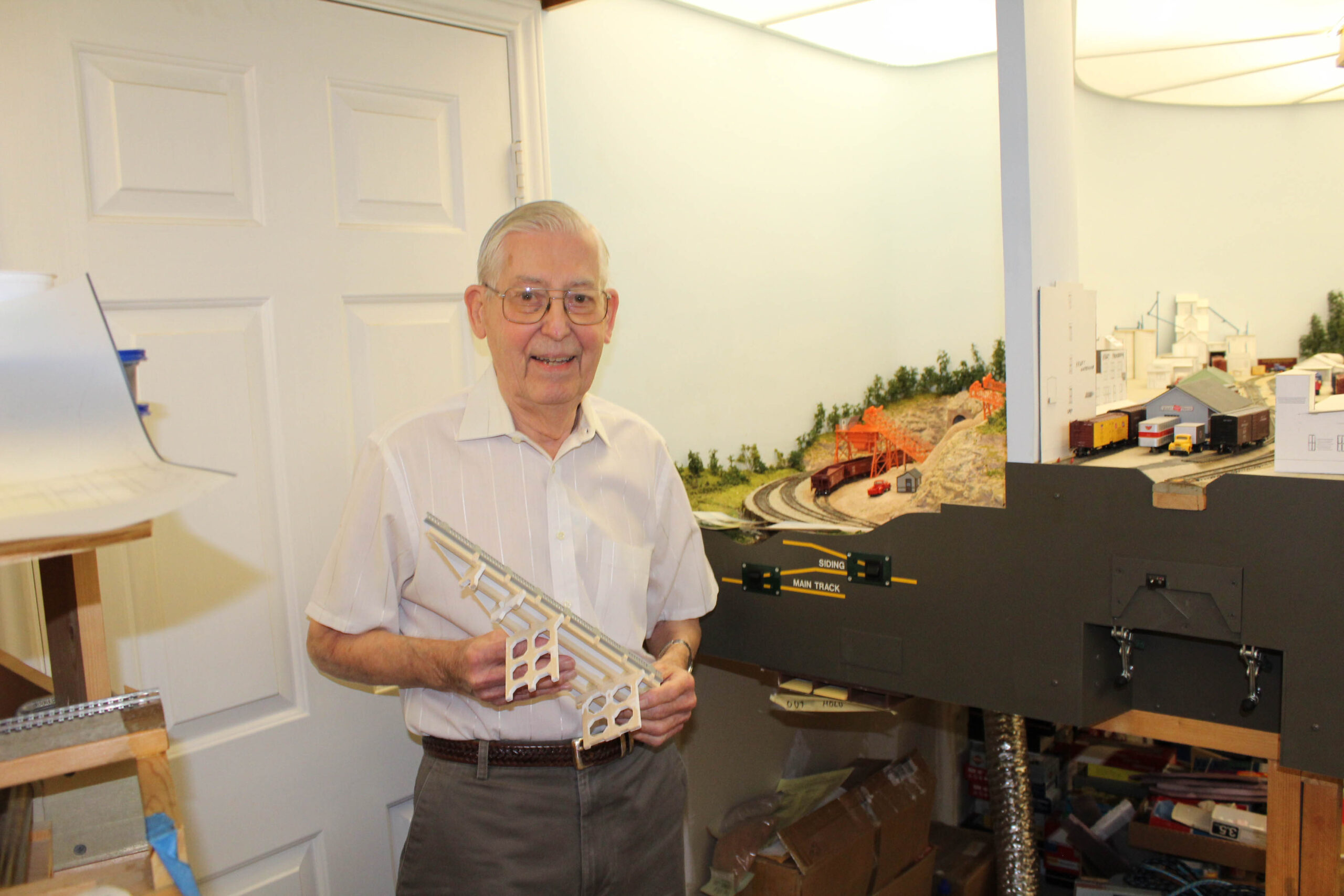
Photo courtesy of Dallas Area Train Show/ North Texas Council of Railroad Clubs.
The retired mechanical engineer from Cedar Rapids, Iowa, has recreated locations — including his hometown — from his childhood. He’s installed a specialized framework to put HO gauge trains and their tracks at eye level, and he’s set up dedicated lighting to monitor tiny details. An enhanced air conditioning system keeps the temperature perfect year ‘round for people and trains alike.
“I’ve been interested in trains since I could say ‘choo-choo,’” Keyser says. “All through elementary school, high school and college, I was into it deep.”
Keyser is dedicated to realism and accuracy, and he’s focused on prototype models from one specific year — 1954. American trains that year were in the process of transitioning from steam to diesel, and each model he runs was operating in Belle Plaine, Iowa, where he often visited extended family.
“I joined the National Model Railroad Association back in 1954, and I’ve gone to hundreds of national and local conventions since then,” he says. “I’ve given over a hundred modeling clinics, written 42 magazine articles and had four books published on the Chicago Northwestern Railroad.”
To build the extensive setup in his home, Keyser removed a large section off his roof. At the time, he reassured his dear, now-departed wife Mary that the move would only be temporary.
“I got a 40-foot pool cover to put over the roof while we were working, and when I came home from work, I would roll back and remove the existing roof. I designed a truss from wall-to-wall, 14 inches deep. I put in 27 of those and decked it, and I got a contractor to help me build the walls, creating a 16-by-36-foot open room.”
Mary, he claims, was encouraging throughout.
“She was a big supporter,” says the 94-year-old. “This is a fantastic hobby. It keeps me alive. It keeps me thinking. It keeps me going. She always knew where she could find me if I was missing.”
Keyser was like many American children of that era — at the age of 3, he started with a windup train, and at 4, he found a Lionel set under his Christmas tree. That gift from his father sparked something inside him which has lasted 90 years, and he keeps that first train on a shelf over the antique desk in his workroom.
“I was ecstatic to get it,” he recalls. “My grandfather and dad built a train table in the basement 4-by-8-foot, I think it was. They had tracks and switches and so forth, and I played with that all the way into high school.”
As a young boy, he recalls borrowing his cousin’s bicycle, riding to downtown Belle Plaine, sitting on the foundation of the signal bridge on Seventh Avenue and watching the trains. He admired a few relatives who worked on various aspects of the railroad system during World War II — from conductors to brakemen to roundhouse pipefitters. When he got to high school, he admits to bumming rides on the Illinois Central caboose from Cedar Rapids to Manchester.
“You’ve got to talk your way into that,” he laughs. “I left my bicycle over in the weeds, and sometimes I’d ride a freight train from Cedar Rapids down to Silvis, Illinois, and back.”
Keyser has meticulously researched the schedules for 1954 trains across the Midwest and recreated towns and structures from Belle Plaine, Iowa, to Plymouth, Wisconsin, to Wausau, Wisconsin. Each train car has a color-coded card, not unlike an old-fashioned library card used to check out books. The cards indicate whether the train car is a “set out” on a side track or a “pick up,” ready to be added to the train.
“All of the cars you see here are ’54 or before,” he explains. “I’ve built a lot of them, but not all, and I’ve built the backgrounds, including buildings, silos, stations and trees. That bridge, for example, is on a highway in Missouri. I photographed, measured and drew and scratch built it.”
It’s not enough, Keyser says, to just “put a bridge” on the track. He requires the period-appropriate scene from the burgh he is recreating. He visits the town and sizes it up, then heads straight to their library or preservation society. He looks for books with old photos which depict the downtown area from 1954.
He wants to get it right.
“I drove into this town on one of my trips and thought, ‘Man, there are some super buildings here. I have a place for that town.’ So, I started taking photographs and doing building mockups.”
Keyser’s idea of a perfect site is one with a condensed downtown or industrial district, with buildings clustered close together around the train depot. Of course, in 1954 small town America, trains were more pivotal to commerce than they are today.
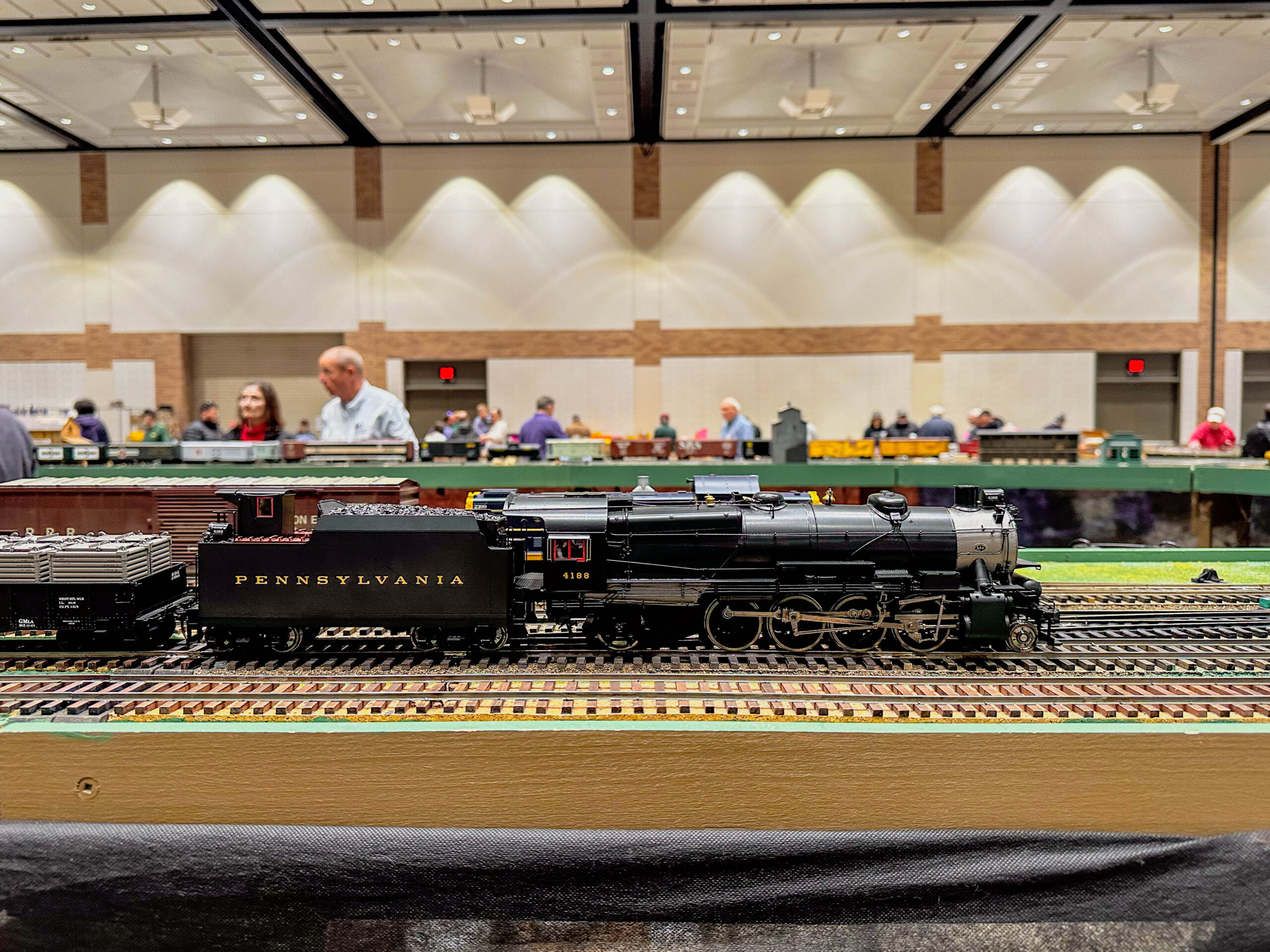
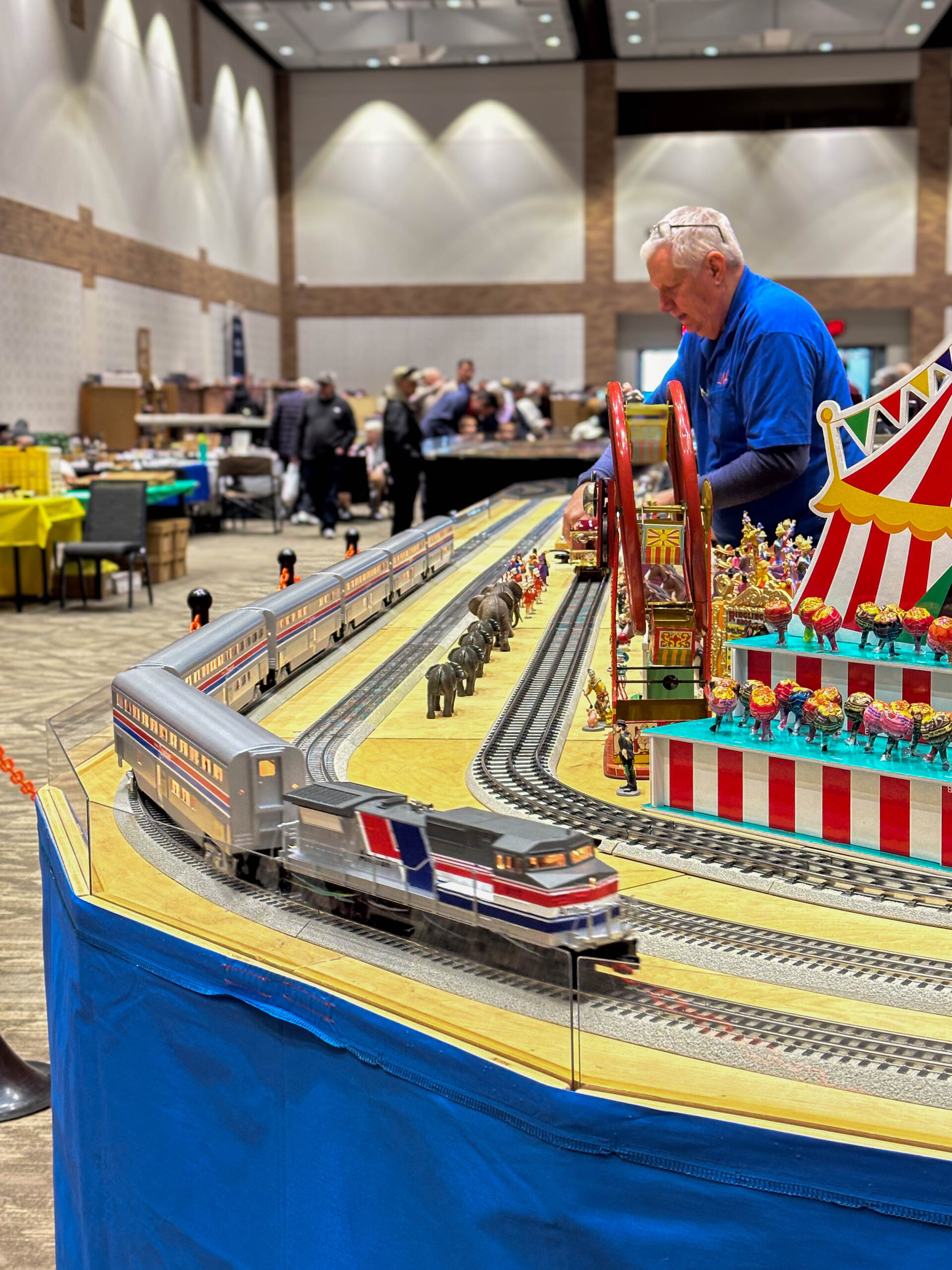
In some cases, he purchases train cars exactly as he wants them to look, and in some cases, he builds them from scratch. Often, it’s a mixture of the two. In a technique called “kit bashing,” he takes parts from different model kits and combines them to create exactly what he wants.
“The black portion of this car is primed and ready for paint came from a car kit,” he says. “It’s very accurate — exactly what I needed. I just extended the sides, put a roof on it and detailed the ends. Everything you see that’s light in color I built from Styrene (a kind of plastic). It’s all scratch built.”
Train enthusiasts generally fall into three camps — collectors, interested in finding mint condition train cars in their original boxes and displaying them, and freelance and prototype modelers, who select a specific era and railroad. Of the quarter million modelers in the United States, Keyser is part of the smaller subset called prototype modelers. He gets together with 10 fellow model railroaders to eat breakfast every Friday, and the long-time buddies make plans for their next operating session. Once a month, they gather to run the trains.
At age 94, Keyser is realistic about his future — and the future of the trains. When he’s gone, the new homeowner isn’t likely to want to keep the specialized setup, so he’s already making plans. The train set will be sold or given away, and the wires and switches will be salvaged. The benchwork will go straight into the trash.
Keyser travels often to give clinics on modeling, but not as many young people are taking up the hobby these days.
“There used to be people doing more of this,” he says of building cars and backgrounds from scratch. “Young people today like to take it out of the box, set it on the track and run it.”
He does have advice for neighbors who’d like to spark an interest in their child or grandchild.
“I suggest beginning with the Lionel set,” he says, pointing to the antique model on his wall. “You can always build on that with a little encouragement. And take them to the big train shows, like the ones held in Plano. Between Saturday and Sunday, close to 20,000 people walk through that show.”
The Dallas Area Trail Show will be held Jan. 17-18, 2026, at the Plano Event Center, 2000 East Spring Creek Parkway. Admission is $11, and children under 13 are free. There will be two full days of clinics, plus tables, vendors.
