

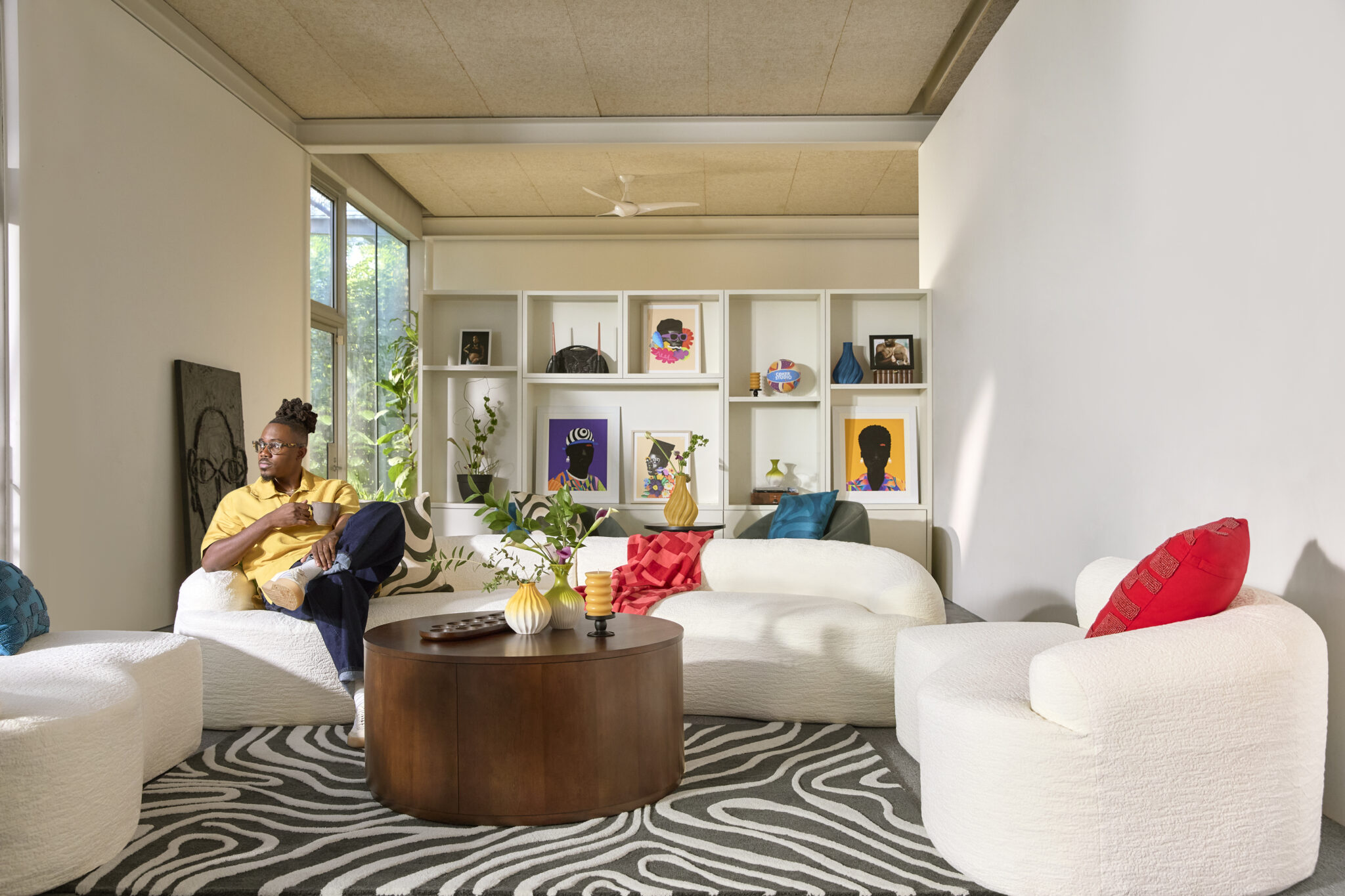
Oak Cliff neighbor Temi Coker released a home collection with Walmart. Photo courtesy of Temi Coker.
Multidisciplinary artist Temi Coker debuted his collaboration with Walmart today.
The 18-piece home collection is made up of vibrant blues, reds, yellows and greens along with stark contrasts of black and white.
Coker has designed campaigns for brands like Apple, Nike, Google and Adobe, but was interested in creating things that could live in people’s homes. Through his own venture, Coker Studio, he has released clothing items, posters and even a basketball.
“I wanted to create just a space where I could imagine what I want to see in the world,” he said. “I also designed the pillow (for Coker Studio), which is what brought this Walmart collaboration. My wife was like, ‘Your designs look great on jackets and stuff, but you should make a home collection. You should make a pillow for the house.’ Kind of said it jokingly, but I decided to make it.”
Nearly a year in the making, the collection of pillows, rugs, blankets and vases is now available, ranging in price from $14 to $320 per item. Each piece ties back to his roots in Lagos, Nigeria.
“I was born in the Yoruba culture. My dad is Yoruba, and in our culture, whenever you have birthday celebrations, weddings, things like that, we wear something called Aso Oke, which is woven fabric,” Coker said. “When I was growing up, it was very colorful. Nigeria was loud, but colorful and loud in a beautiful way.”
The collection also highlights the duality that comes with his immigrant identity.
“When we came to America, it was a culture shock, because I was African, and I didn’t really identify with the African American community here. So, that’s why in the home collection, you see a lot of duality,” he said. “There’s this duality of different colors, because I have now been in America for 21 years. I’m 33, and I’ve lived in both cultures, and I know what that’s like. And my wife is African American. We have two kids now, a 19-month-old and a 3-month-old, and they’re going to live in this duality as well.”
The duality he indicates is in the paired colors of the different pieces. For example, one version of the rug has blue on blue, but in different shades. Some of the vases are the same, but are also available in green and white or yellow and white, representing that duality of his own family.
“The whole idea with the vases was an ode to my wife carrying both babies, and they’re reminded that the vase is as important as the bloom,” he said. “So I made these different vases inspired by that, but also, some of them have textures of our African American hair.”

The vases of the collection are an ode to Coker’s wife, whom he buys flowers for each month on her birth date. Photo courtesy of Temi Coker.
Coker said that the pieces are also about legacy, the stories and things passed down from generation to generation. For example, with the rug he wanted to show migration of African Americans by sea through the pattern, and the pillows that are handwoven are like the Aso Oke made from scratch in Nigeria.
“In my work, I’m really big on texture. I want people to feel things. I want things to feel different,” he said.
The feeling for the collection is not only literal, but emotional.
“I realized that our homes, our living rooms are a safe space. They see our vulnerability, to see the best and worst sides of us,” he said. “And I find a lot of joy in knowing that this is going to live in people’s homes for a long time.”
With the collection’s release just in before Black History Month, Coker also spoke of what he hopes it will show the community.
“I think about the young African kid who their parents told them, ‘You have to be a doctor, lawyer, nurse and nothing else.’ And that was my story, and I switched my major from biomedical engineering to digital media, and that was rough, but I bet on myself, and I felt like God was calling me to the arts,” he said. “People didn’t understand back then. And you know, it’s been 12 years since I graduated college, and I think people see the vision now, and I want young African, Black kids to know that it is possible to pursue dreams and creativity.”
