
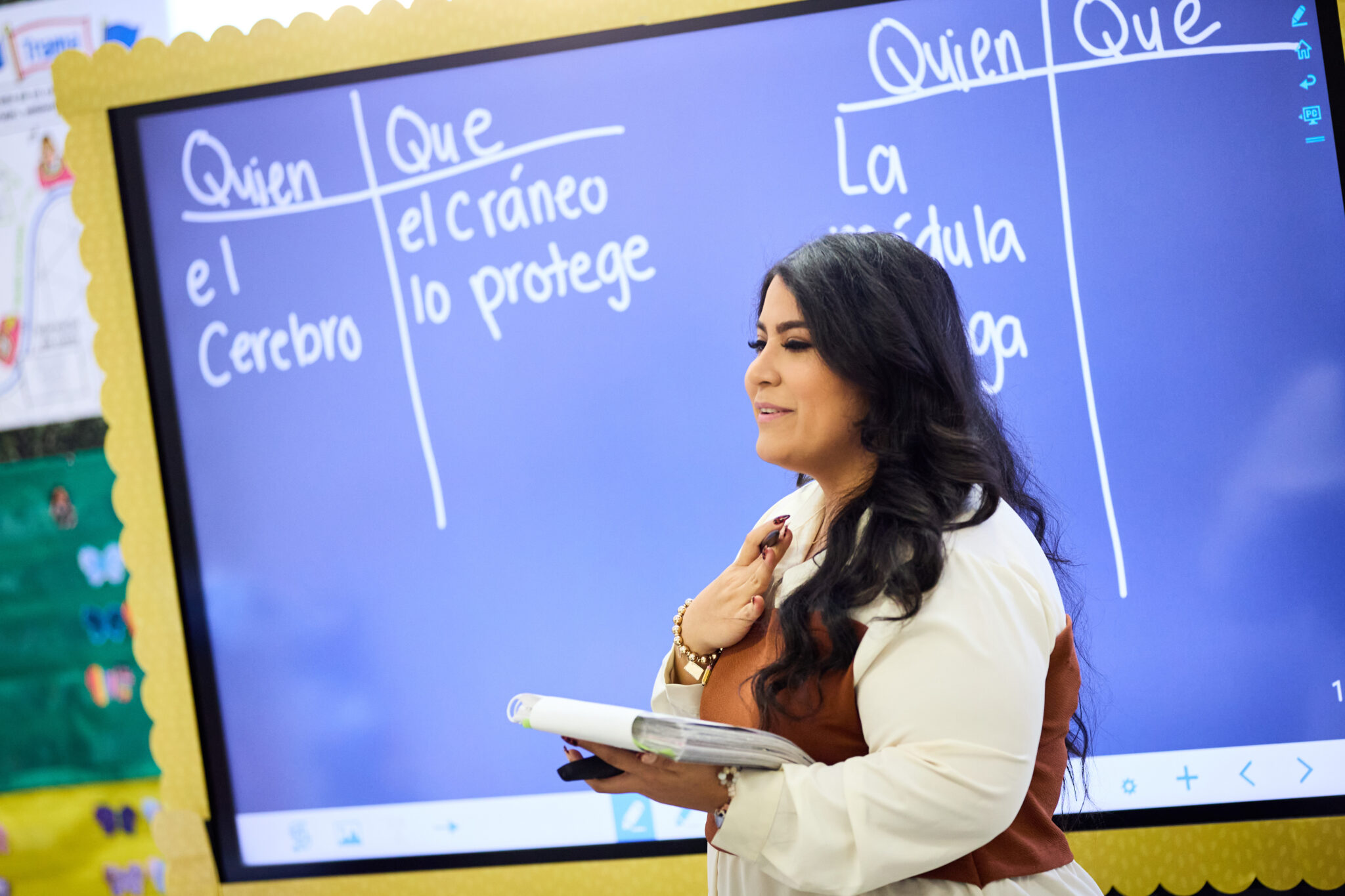
Keylah Pineda, a teacher at Jimmie Tyler Brashear Elementary School, speaks during a lesson in her classroom in Dallas. Photo courtesy of The Holdsworth Center.
Sonja Barnes is going on over a decade of her career spent as the principal of Jimmie T. Brashear Elementary. Quickly into her time at the campus, she saw a struggle in her students that she couldn’t shake.
“Around the third or fourth year, I started noticing that we were having more students that were struggling with taking their (STAAR) assessments in Spanish and English. It seems like they were really struggling,” she said. “And my teachers were trying to figure out what could we do to make a difference. And we just decided, we realized. My teachers kept saying it’s the vocabulary. They don’t know it in English, and they don’t know it in Spanish.”
The language barrier was happening specifically when it came to academic words.
“Our kids are used to the Spanish that they speak at home with their mother, father, grandparents, but the academic language is at a very high level. And then, of course, if you’re learning two languages, and your native language is Spanish, of course, your English language vocabulary is going to be limited also. The data was reflecting that, that it was in the vocabulary,” Barnes said. “And so we were trying to think of what are some things that we can do to help build our students’ vocabulary, because it was with not just words that are higher level, but just some basic words that they were struggling with, like, maybe a word, like, important, you know, why is this important to the story? Important might be a word that they’re not familiar with.”
The campus began experimenting with computer-based strategies and an exercise known as a “word wall,” where students would physically place words on the wall as a game to help address the vocabulary barrier.
“It was great, but it didn’t seem to make that connection. They kind of learned the word, and they kind of didn’t,” she said. “They had fun with the game, but we didn’t see the increases when they moved into their reading. It just didn’t seem to be a connection there.”
Barnes took this problem to The Holdsworth Center’s Campus Leadership Program, a two-year program for principals and their teams to drive positive change on their campus. She joined the experience in 2022 through a collaboration with Dallas ISD, and during the duration of the program, brought in more team members, both from the lower grade and the upper grade levels of the campus, whom she saw had a disconnect. Eventually, the group decided to focus on addressing vocabulary for the second graders of the elementary campus.
Keylah Pineda was one of the teachers selected, specifically working as a bilingual teacher for lower-grade students. This year, she started teaching third grade students after serving Brashear Elementary for eight years.
Working with Holdsworth was the first leadership development program she said she had done in her career.
“I was really, really shy. I was the kind of person who kind of hung in the background. I didn’t take initiative. I would collaborate with my team members, but I was just kind of hanging in the background,” Pineda said.
Throughout the two-year program, she participated in team building that she said pushed her to speak up more, collaborate more and become more confident.
Her classroom, as a former second grade teacher, then became the testing ground for a vocabulary approach that finally clicked with the bilingual Brashear students. The TIP chart (Text, Information, Picture) allowed their students to take leadership in their own learning, she said.
“One of my favorite moments was when I realized that it was actually working,” Pineda said. “When I saw it was clicking was whenever they were using a high-level vocabulary like, we were using the word engreído, which is kind of like vain, someone who thinks very highly of themselves. And they were using it in their academic conversations. They were using it in their writing to describe this character, and I was like ‘Oh my gosh, you guys actually know what that means.’ So they were able to recall because they were doing it with the kinesthetic approach.”
By the end of the program, 80% of their second grade English learners jumped to the top tier in language, which led all students at Brashear to reach an 88 for the Texas Education Agency overall accountability rating.
“Being able to grow others and distribute the leadership is very important to me, because especially now that we’ve completed Holdsworth,” Barnes said, “… you can see how Ms. Pineda and Ms. Creighton (another teacher in the program) brought things back to the campus, and we have closed that divide between the upper grade and lower grade, as well as working on the vocabulary development for our kids.”
