
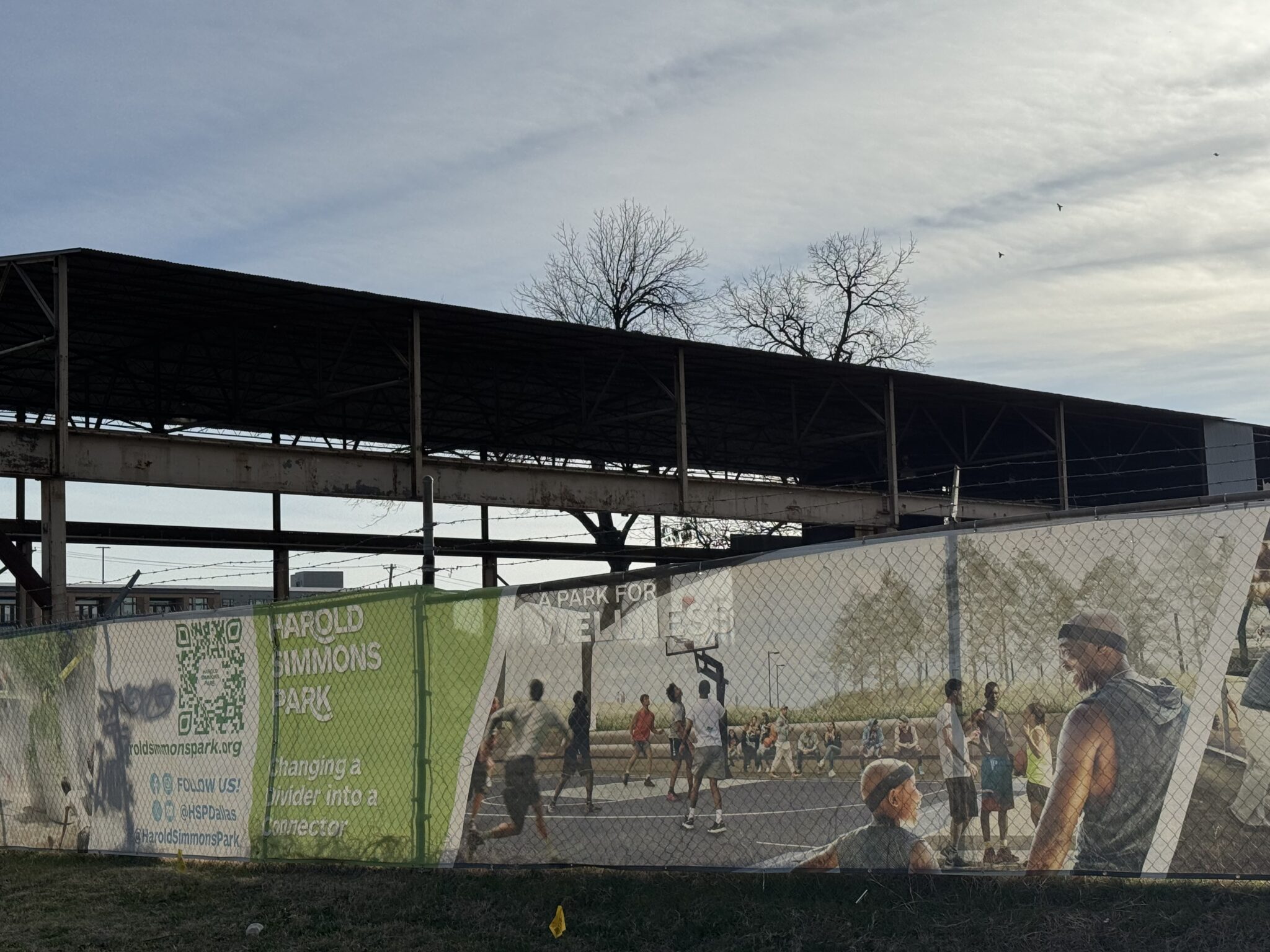
Photo by Victoria Hernandez.
The largest planned park in the City of Dallas is starting to take shape, but not entirely on home soil just yet.
Trinity Park Conservancy, the nonprofit tasked to help bring “the vision of the Trinity River to life,” broke ground last April on Harold Simmons Park. Originally slated for 200 acres of flood-friendly park running from the Ron Kirk Pedestrian Bridge in the north to the Margaret McDermott Bridge in the south, the project has moved up and beyond with five additional sections to total 250 acres and approximately $325 million.
This change was due in part to the U.S. Army Corps of Engineers’ work in the floodway. The construction to replace the Delta Pump Station is expected to be completed by the end of 2027, according to a city memo.
“Dallas has been waiting for this park for so long, so we had to move in urgency to get something built and get something delivered to the citizens of Dallas,” Trinity Park Conservancy president and CEO Tony Moore said. “And so, to be honest, we’re 30 years late in doing something. We did not have the luxury of waiting anymore.”
The solution was to move out of the flood zone area. Rather than through “small pocket parks,” Harold Simmons Park is a contiguous park so that the design is more comprehensive, Moore said.
One of the sections beyond the levees is the West Overlook, which will be the first portion completed on the project. This 22-acre park includes what staff calls “the heart of the park” with an event shed, water factory, event lawn, picnic grove, playground and nearly 2,000 mature trees that will be planted throughout the area. The entire section will develop through two phases over the next three to three and a half years, according to a September Dallas Business Journal article.
The playground is currently taking shape abroad in collaboration with landscape design firm Michael Van Valkenburgh Associates (MVVA) through German-based manufacturer Richter Spielgeräte.
“The German-based manufacturer is the preferred playground manufacturer for MVVA and so there was a little bit of packaging there,” Moore said, “but I will tell you that the quality of work that they do and the durability of the products that they do … I would argue to say that they’re the best playground manufacturers in the world, and so it allows us to give Dallas the very best.”
Moore noted that MVVA designed the Brooklyn Bridge Park in New York, the Maggie Daley Park portion of Chicago’s Millennium Park and the Gathering Place in Tulsa.
“They stand behind their product so well, and so having the fact that they’re in so many U.S. tier one parks, we didn’t want any less for this park here in Dallas,” he said.
As progress continues on the project, Trinity Park Conservancy hasn’t completely closed the door on land acquisition.
“We have the property for the park, and that’s why we’re building the park. If property becomes available, we’ll certainly look at it, but we’re heavy fundraising right now to build the park. But when you’re doing a development master plan, you don’t want a gas station to come in and buy a piece of land right next to you that doesn’t fit the experience of that, if that makes sense … you wouldn’t want a strip mall going up right next to your park,” Moore said. “And so we have the land that we need for the park secure, but if there was land that’s close by that became available, of course, we would definitely be interested if we can find the means to buy.”
Like with Halperin Park, which is estimated to open this spring, there are concerns about higher property taxes and displacement within the community.
“The last 10 years, West Dallas has been, unfortunately, dealing with the growth of Downtown, jumping the river, and so there is gentrification that comes with growth, and that’s part of what Dallas is struggling with,” he said. “We, however, are trying to do what we can to help to mitigate the displacement. And so we are trying to find the role that we can play and not overextend ourselves in an area that we don’t have the competence, but we have worked with local groups on property tax education, home ownership education (and) property tax protesting.”
Future plans are in the process for tax season to host a seminar in partnership with UNT Dallas, and continuing collaborations with Builders of Hope and the city.
“This is a big macro issue that’s impacting Dallas, and this has been an existing issue even before we got to the point of breaking ground,” Moore said. “And so this is a little bigger than us, but at the same time, we are cognizant to our closest geography and trying to see what we can do to help to mitigate some of it.”
Moore joined Trinity Park Conservancy in 2021 from the Gathering Place, where he served as CEO for five years. Although he comes with experience outside the city, Moore said that for the most part, the staff is made up of Dallasites and those who live around the area.
“We do have a few from the outside, two out of 15 (team members). Everyone else is really from the Dallas area or lived in Dallas; (they) live, play and work in Dallas. And so this is very much a Dallas-centric project supported by Dallas,” he said. “And important to note, that our donors that’s fundraising to help to build this park are also Dallas-based. So this park is as Dallas-centric as Dallas gets.”
But the work Trinity Park Conservancy is doing is more than just a park, Moore said.
“This is enhancing the quality of life in the city that we live, work and play in, and so we feel the obligation to deliver, and we’re working hard to do so.”
